IP Rating Chart and IP Code Decoder
Type an IP code to read what dust and water protection it promises, compare two ratings, or use the full chart of both digits.
Popular tools
- Parallel Resistor CalculatorList your resistor values to get the total resistance in parallel and in series, the current in each, and a standard pair for a target.
- Low Pass Filter CalculatorEnter the components to get the cutoff frequency, or a target frequency to get the component, with the response drawn on a Bode plot.
- Resistor Color Code CalculatorPick the colour of each band to read the resistance and tolerance, or type a value to see its colour bands.
How to use the IP Rating Chart
- Open the tool at the top of this page.
- Choose a mode: decode one IP code, or compare two codes.
- Type your code, for example IP65, IPX4, IP6K9K or IP69K. The results update as you type.
- Read the plain-English meaning for each digit. A letter such as X means the digit was not tested, which is not the same as 0.
- Look at the grid of first and second digits. Your current code is marked in it.
- In compare mode, enter a second code and read the differences digit by digit.
- Open “How it was calculated” to see the formula and each step with your numbers.
Copy result copies the result lines with a link. Copy link copies the page address, which stores every input (the ?s= part), so opening it later restores the same calculation. Print / save as PDF prints the inputs, results, calculation steps and the date.
The presets show IP65, IP67, IP69K and a comparison of IP67 with IP68. The full grid at the bottom of the page is an IP classification chart of every first and second digit, with the code you entered marked; you can print it with Print / save as PDF.
What does IP65 mean?
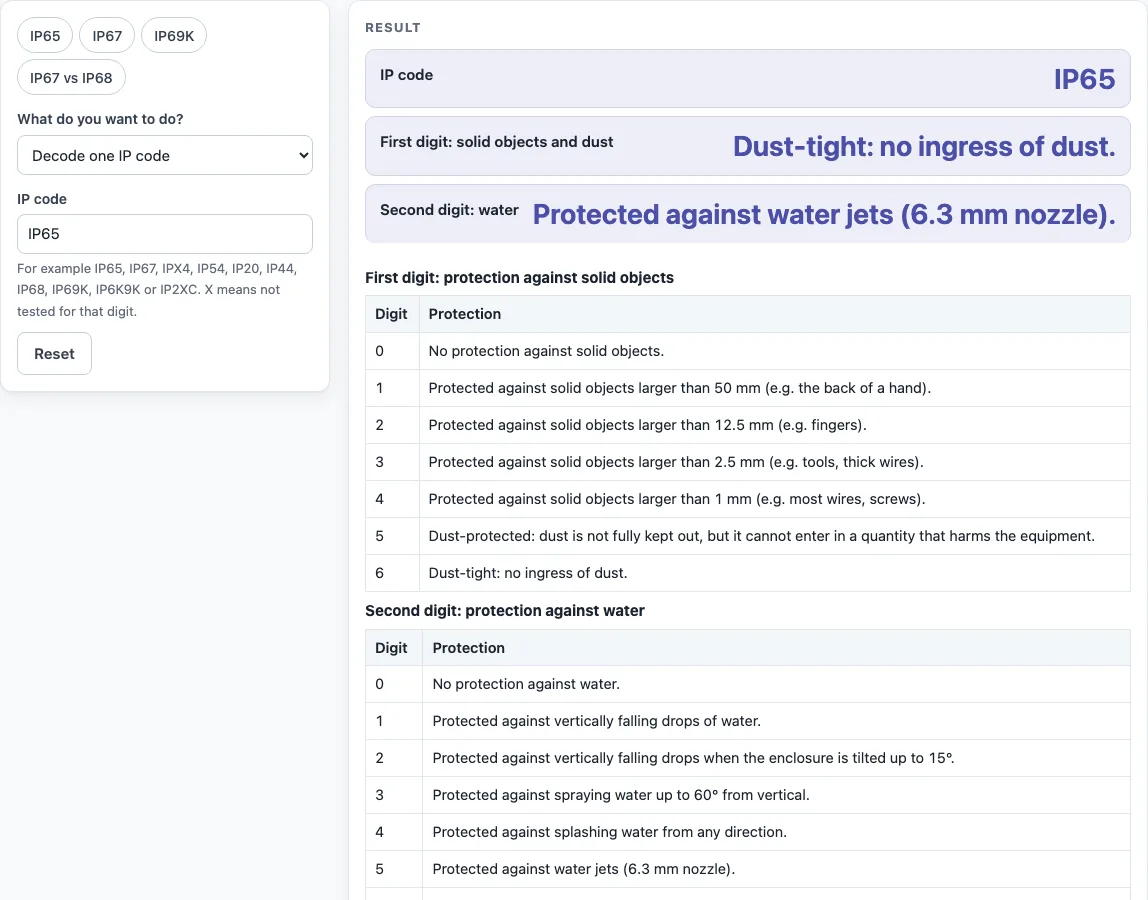
IP65 means the product is dust-tight and protected against water jets. The first digit, 6, covers solid objects and dust, and the second digit, 5, covers water.
Level 6 for dust means no ingress of dust. Level 5 for water means water jets from a 6.3 mm nozzle cause no harm. The rating does not say the product survives immersion, because immersion is a separate test at digits 7 and 8.
What do the two numbers in an IP rating mean?
The first number rates protection against solid objects and dust. The second number rates protection against water. Each digit is read on its own, and each scale starts at 0, meaning not protected.
First digit (solids and dust):
- 1: objects over 50 mm, such as the back of a hand
- 2: objects over 12.5 mm, such as fingers
- 3: objects over 2.5 mm, such as tools and thick wires
- 4: objects over 1 mm, such as most wires and screws
- 5: dust-protected, where some dust may enter but not enough to harm the equipment
- 6: dust-tight
Second digit (water):
- 1: vertically dripping water
- 2: dripping water with the enclosure tilted up to 15°
- 3: spraying water up to 60° from vertical
- 4: splashing water from any direction
- 5: water jets from a 6.3 mm nozzle
- 6: powerful water jets from a 12.5 mm nozzle
- 7: temporary immersion up to 1 m for 30 minutes
- 8: continuous immersion beyond 1 m, under conditions agreed with the manufacturer
- 9K: high-pressure, high-temperature close-range jets (ISO 20653, road vehicles)
Optional letters add detail. A, B, C and D mark access protection against a back of hand, a finger, a tool and a wire. H, M, S and W mark high-voltage apparatus, testing while moving, testing while stationary, and weather conditions.
Is this an IP certification chart?
It is a chart of the IP degree of protection classification defined in IEC 60529, not a certificate. A product’s IP rating is the manufacturer’s claim based on type tests to that standard; ask for the test report when the rating matters, for example for outdoor enclosures or washdown equipment.
Sources
Checked October 2026:
- Wikipedia, IP Code for the IEC 60529 first and second digits, the extra letters and the IPX7 / IPX5 dual-coding rule
- Siemens, IP vs. NEMA white paper for the IEC 60529 digit table
For estimation; verify critical designs against the applicable standard.
Worked examples
| Input | Result |
|---|---|
| IP65 | Dust-tight: no ingress of dust. Protected against water jets (6.3 mm nozzle). |
| IP54 | Dust-protected: dust is not fully kept out, but it cannot enter in a quantity that harms the equipment. Protected against splashing water from any direction. |
| IPX4 | Not tested for solid objects and dust (not the same as no protection, which is 0). Protected against splashing water from any direction. |
| IP69K | Dust-tight: no ingress of dust. Protected against high-pressure, high-temperature close-range water jets (written 9K in ISO 20653, road vehicles). |
| IP67 against IP68 | Solids: Same level. Water: IP68 gives more protection than IP67. |
Calculated by the tool above with these values.
Frequently asked questions
What is the difference between IP67 and IP68?
Both give the same level of dust protection, so the first digit is 6 for each. IP68 gives more water protection than IP67, because it covers continuous immersion beyond 1 m, not just temporary immersion up to 1 m.
What does the X in IPX4 mean?
The X means the product was not tested for solid objects and dust. It does not mean zero protection, which is written as 0. IPX4 only tells you the product is protected against splashing water from any direction.
What is IP69K?
IP69K is a rating for high-pressure, high-temperature, close-range water jets. ISO 20653 writes this as 9K, and it is used for road vehicles. It also includes dust-tight protection, as the first digit is 6.
Is IP67 waterproof?
IP67 protects against dust and against temporary immersion up to 1 m for 30 minutes. It does not automatically cover IP65 or IP66 jet tests, so a product marked IP67 alone was not tested against those jets. For prolonged or deeper immersion, look for an IP68 rating and check its test depth and time on the datasheet.
What IP rating do I need outdoors?
Match the second digit to the water the equipment will meet. Splashing or light rain points to 4, hose-down jets point to 5 or 6, and occasional immersion points to 7. Pair this with a first digit of 5 or 6 if dust is also a concern.
Are IP ratings guaranteed by the chart?
No. The chart decodes the code, but ratings are claimed by the manufacturer from type tests. Check the product’s datasheet for the test conditions, especially for IPX8, where depth and time matter.
Related tools
- NEMA enclosure rating chart: use it when a product lists a NEMA type instead of an IP code.
- PT100 table: use it to look up resistance values for PT100 temperature sensors.
- 4-20 mA calculator: use it to convert between current signal and the measured value in a 4-20 mA loop.
- PLC simulator: use it to test control logic before wiring a PLC.
- Motor torque calculator: use it to estimate the torque a motor needs for a load.
- All calculators: use it to browse every tool on the site.