Capacitor Code Calculator
Type the code printed on a capacitor to get its value in pF, nF and µF, or find the code for a value.
This capacitor code calculator reads the small number printed on a ceramic or film capacitor and gives its capacitance in picofarads, nanofarads and microfarads. Type a code such as 104K, 473K 330V or 221 and the value appears at once, with the tolerance and the working voltage if they are printed. It also reads the RKM form such as 4n7, and works the other way: enter a capacitance and get the three-digit code to look for.
The calculator is free, runs in your browser, needs no sign-up, and nothing is uploaded. It covers the three-digit code with the tolerance letters J, K and M, and the RKM notation. It does not read colour-banded capacitors or the two-character codes of very small parts.
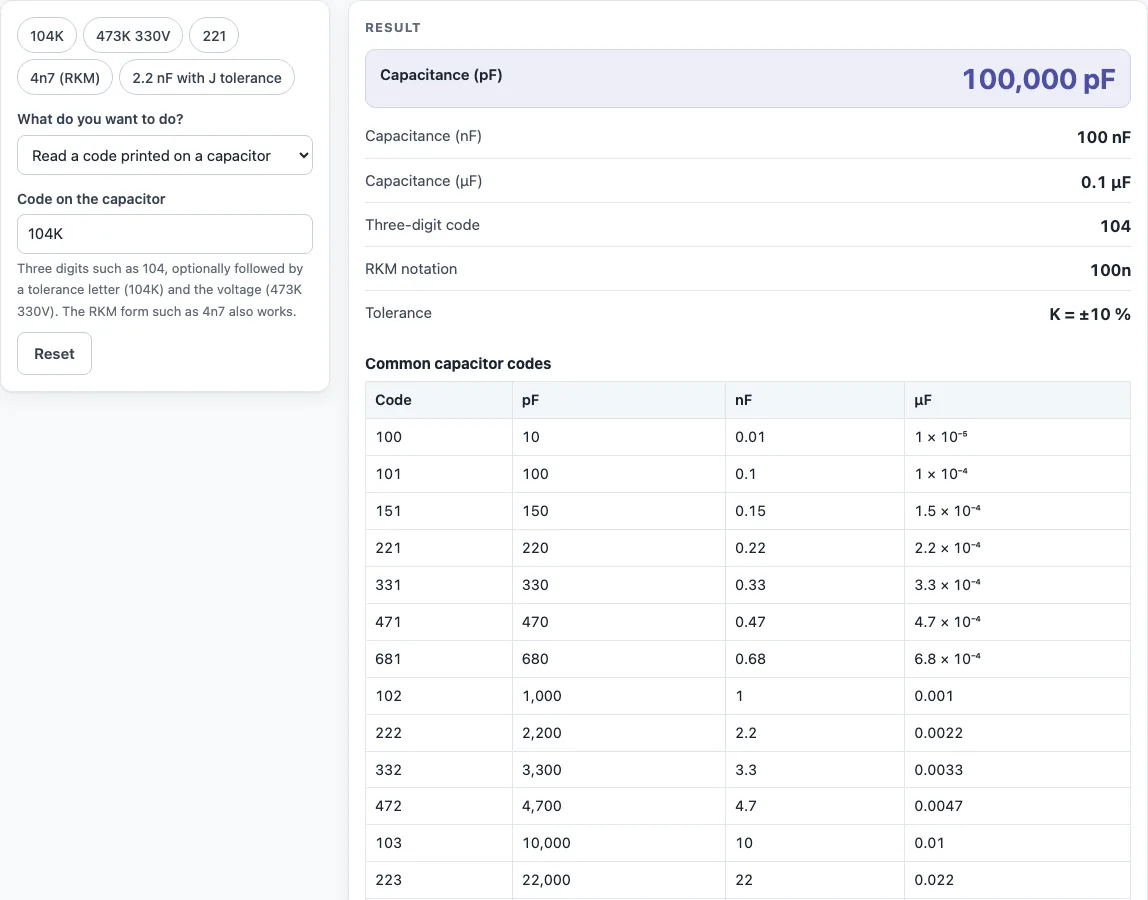
How to use the capacitor code calculator
- In What do you want to do? choose Read a code printed on a capacitor, or Find the code for a capacitance.
- To read a code, type it into Code on the capacitor. Examples: 104, 104K, 473K 330V, 4n7. Capital or small letters both work.
- To find a code, type the Capacitance and choose pF, nF or µF. Optionally pick a Tolerance letter (optional): J, K or M.
- Read the main result: Capacitance (pF) when reading a code, or Three-digit code when finding one.
- The other rows show the Capacitance (nF), Capacitance (µF), the Three-digit code, the RKM notation, the Tolerance and the Working voltage printed.
- Open How it was calculated to see the steps. The table under the result lists the most common codes, from 100 to 106.
The example buttons above the form, such as 104K and 473K 330V, load a finished case. Copy result, Copy link and Print / save as PDF sit under the result. Copy link stores your inputs in the page address, so the same calculation reopens later, and Reset returns the form to its starting values. If the code has a letter that is not J, K or M, the calculator still gives the value and adds a warning, so you know to check the data sheet.
How do you read a three-digit capacitor code?
The first two digits are the significant figures and the third digit is the number of zeros to add, giving the capacitance in picofarads: XYZ = XY × 10^Z pF. Wikipedia’s article on capacitors uses the example 473K 330V, which is 47 × 10³ pF = 47 nF. So 104 means 10 followed by four zeros, 100,000 pF, which is 100 nF or 0.1 µF.
What does the letter after the code mean?
The letter is the tolerance. J means ±5 %, K means ±10 % and M means ±20 %. Other letters exist on some parts, and the calculator tells you when it does not know a letter, so check the manufacturer’s data sheet. A number such as 330V after the code is the working voltage, the highest voltage the part is meant to see.
What is the value of a 103 capacitor?
103 is 10 × 10³ pF = 10,000 pF, which is 10 nF or 0.01 µF. A 104 capacitor is 100 nF, a 102 is 1 nF (1,000 pF) and a 105 is 1 µF. The reference table under the result lists these codes with their values in pF, nF and µF.
What is RKM notation such as 4n7?
In the RKM code the letter of the unit takes the place of the decimal point: 4n7 means 4.7 nF, 2µ2 means 2.2 µF and 100n means 100 nF. It avoids a dot that could be lost in printing. The calculator reads p, n and u (or µ) and shows the RKM form of every value.
How do I find the code for a given capacitance?
Write the value in picofarads with two significant digits, and count how many zeros follow. 2.2 nF is 2,200 pF = 22 × 10², so the code is 222. The calculator rounds to two significant digits, because that is all the code can hold, and warns when it had to round. Values below 10 pF are not written in this code.
Worked examples
| Input | Result |
|---|---|
| code 104K | 100,000 pF = 100 nF = 0.1 µF |
| code 473K 330V | 47,000 pF = 47 nF = 0.047 µF |
| code 221 | 220 pF = 0.22 nF = 2.2 × 10⁻⁴ µF |
| code 4n7 | 4,700 pF = 4.7 nF = 0.0047 µF |
| 2.2 nF, tolerance J | code 222J |
| 1 µF | code 105 |
Calculated by the tool above with these values.
Frequently asked questions
What does 104 mean on a capacitor?
104 means 10 × 10⁴ pF, which is 100,000 pF, 100 nF or 0.1 µF.
Is 473 the same as 47 nF?
Yes. 473 is 47 × 10³ pF = 47,000 pF = 47 nF = 0.047 µF.
What does the third digit mean if it is 8 or 9?
The calculator only handles third digits 0 to 7 and reports an error for 8 or 9. Check the maker’s data sheet for those parts.
Does the voltage in the code change the capacitance?
No. The voltage is the highest voltage the capacitor is meant to see. The calculator shows it as printed and uses it only for display, so the capacitance is the same for 473K 50V and 473K 330V.
How do I check a value with a meter?
Measure the capacitor out of circuit with a meter that has a capacitance range and compare the reading with the calculated value. The reading should fall inside the tolerance, for example ±10 % for K, and ceramic parts may also vary with temperature and voltage.
Can the calculator read a colour-coded capacitor?
No. It reads printed codes only. Old colour-banded capacitors need their own colour chart.
Is a 0.1 µF capacitor the same as a 100 nF capacitor?
Yes. 0.1 µF, 100 nF and 100,000 pF are the same capacitance written in three units, and all three are marked 104.
Why does the code have only two significant digits?
Three characters leave room for two digits and a multiplier. A value such as 123 nF cannot be written exactly, so the calculator shows the nearest code and says what that code stands for.
Related tools
- Capacitor series and parallel calculator: use it to combine capacitors.
- Resistor colour code calculator: use it to read colour-banded resistors.
- RC time constant calculator: use it to find the charge time of a resistor and capacitor.
- Reactance calculator: use it to find the reactance of a capacitor at a frequency.
- Low pass filter calculator: use it to pick filter components.
- All calculators: use it to browse every tool on the site.
Sources
- Capacitor (Wikipedia): capacitor markings: three-character code XYZ = XY × 10^Z pF, the example 473K 330V = 47 nF, tolerance letters J, K, M = ±5 %, ±10 %, ±20 %, RKM notation (4n7 = 4.7 nF)