Capacitors in Series and Parallel Calculator
List your capacitor values to get the total capacitance in series and parallel, how a DC voltage divides and the energy stored.
Capacitor Series Parallel Calculator finds the total capacitance of several capacitors wired in series or in parallel. Type your values into one box, choose the connection, and the total updates as you type. It also shows the total for the other connection, so you can compare the two without a second calculation. Use it to check a series or parallel capacitor formula, confirm a design value, or work through a homework problem.
The tool runs in your browser. It is free, needs no sign-up, uploads nothing, and works on a phone.
It also tells you how a DC voltage divides across capacitors in series.
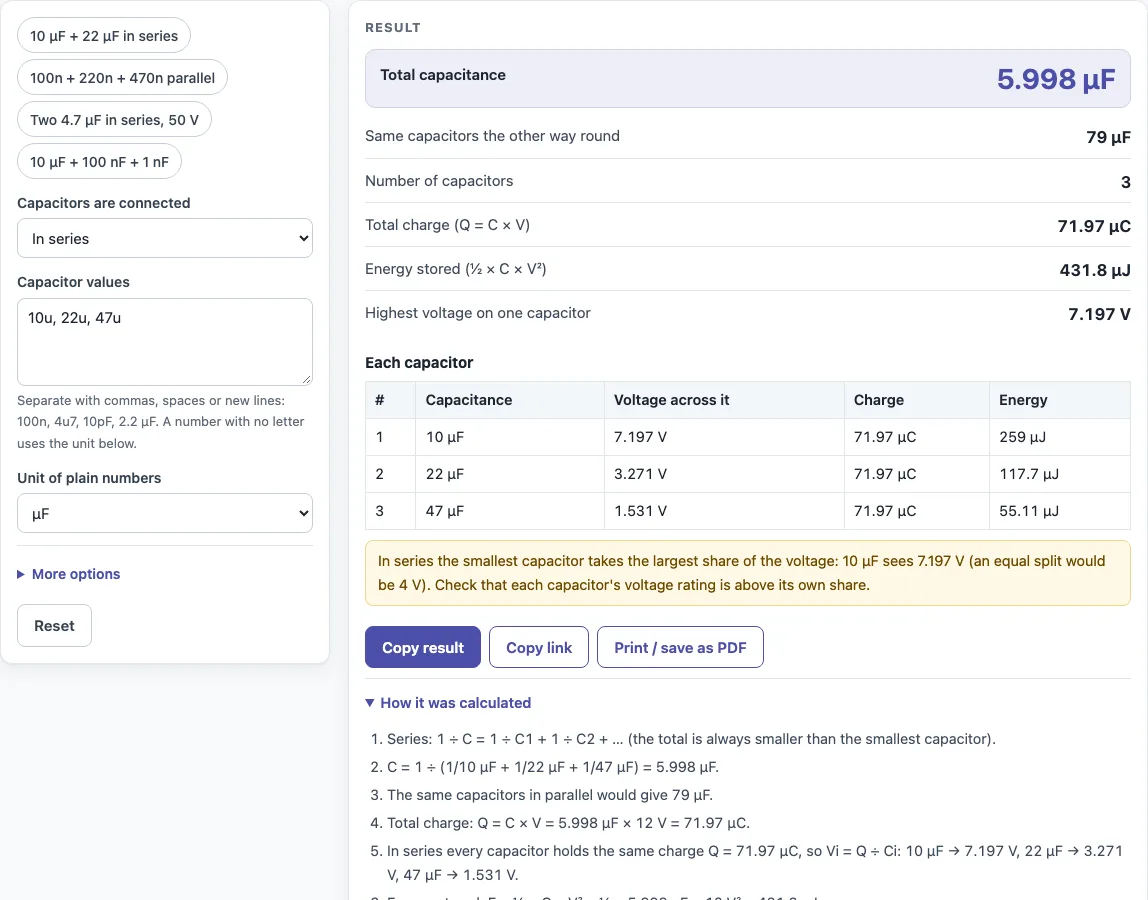
How to use the Capacitor Series Parallel Calculator
- Type your capacitor values into the one box, separated by spaces or commas. For example, type
10u 100n 1nor100n, 220n, 470n. - Use the select to set the unit for plain numbers, from pF up to mF. If you type
uornin a value, that value keeps its own unit. - Choose the connection: In series or In parallel.
- Read the total capacitance for the connection you chose. The total for the other connection appears too.
- To see voltage, charge and energy, open More options and enter your DC voltage. The default is 12 V. The tool then lists each capacitor’s voltage, charge and energy.
- Open “How it was calculated” to see the formula and each step with your numbers.
Results update as you type, so you do not need a button. Copy result copies the result lines with a link. Copy link copies the page address, which stores every input, so opening it later restores the same calculation. Print / save as PDF prints the inputs, results, calculation steps and the date.
The presets show two capacitors in series, three in parallel, two equal 4.7 µF capacitors on 50 V and a decoupling bank.
How do you calculate capacitors in series?
For capacitors in series, add the reciprocals: 1/C = 1/C1 + 1/C2 + …. Then take the reciprocal of that sum to get the total. For 10 µF and 22 µF, 1/10 + 1/22 = 0.14545, so the total is 6.875 µF.
The total is always smaller than the smallest capacitor in the chain. Two equal capacitors in series give half the value of one, so two 4.7 µF capacitors give 2.35 µF.
How do you calculate capacitors in parallel?
For capacitors in parallel, add the values directly: C = C1 + C2 + …. For 100 nF, 220 nF and 470 nF, the total is 790 nF.
The total is always larger than the largest capacitor in the group. Small capacitors add little to a large one. For example, 10 µF + 100 nF + 1 nF gives 10.1 µF. This is the reverse of resistors, where series values add and parallel values use reciprocals.
What is the formula for capacitors in series and parallel?
The two equivalent capacitance formulas are:
- Parallel: C = C1 + C2 + C3 + …
- Series: 1/C = 1/C1 + 1/C2 + 1/C3 + …
Both work for any number of capacitors. For exactly two capacitors in series, the formula simplifies to C = (C1 × C2) ÷ (C1 + C2). Keep all values in the same unit before you add or divide. For three capacitors, 10 µF, 22 µF and 47 µF in series give 5.998 µF.
How is voltage divided across capacitors in series?
In series, every capacitor holds the same charge Q. The voltage on each one is Vi = Q ÷ Ci, so a smaller capacitor takes a larger share of the voltage.
Take 10 µF and 22 µF in series across 12 V. The total is 6.875 µF, so Q = 6.875 µF × 12 V = 82.5 µC. The 10 µF capacitor takes 8.25 V, and the 22 µF capacitor takes 3.75 V. Series connection is also used to raise the voltage rating of a group. Real capacitors need balancing resistors for DC use, because their leakage currents differ.
Why do capacitors in series have less capacitance?
Capacitors in series have less capacitance because the same charge sits on each one while the total voltage is split between them. The group therefore stores less charge per volt than any single member. That is why the total is always below the smallest value.
Sources
Checked October 2026:
- Wikipedia, Capacitor: parallel and series combinations, E = ½ C V², Q = C V
For estimation; verify critical designs against the applicable standard.
Worked examples
| Input | Result |
|---|---|
| 10u, 22u, 47u (In series) | 5.998 µF |
| 100n, 220n, 470n (In parallel) | 790 nF |
| 10, 22 (In series) | 6.875 µF |
| 10u 100n 1n (In parallel) | 10.1 µF |
| 4u7, 4u7 (In series) | 2.35 µF |
Calculated by the tool above with these values.
Frequently asked questions
Can I mix units in one entry?
Yes. Type each value with its own suffix, such as 10u 100n 1n. The unit select only applies to plain numbers without a suffix.
What DC voltage does the calculator use?
It uses 12 V by default. You can change it under More options, and the voltage, charge and energy results update to match.
Why does one capacitor show a warning?
The tool warns when a capacitor in series takes much more than an equal share of the voltage. This happens most often when capacitor values differ a lot.
Is series connection a way to get a higher voltage rating?
Yes, that is one reason to use it. Remember that real capacitors in series need balancing resistors for DC because their leakage differs.
Can I save or share my calculation?
Yes. Copy link copies a page address that stores all your inputs, so the same calculation opens again later.
Why put a small capacitor in parallel with a large one?
The total barely changes (10 µF + 100 nF = 10.1 µF), but a small ceramic capacitor works at higher frequencies where a large electrolytic does not, which is why decoupling banks combine them.
Can I mix units?
Yes. Write each value with its prefix (10u, 100n, 1n).
Related tools
- RC time constant calculator: use it when a capacitor is charging or discharging through a resistor.
- Reactance calculator: use it to find how a capacitor behaves with AC signals.
- Parallel resistor calculator: use it for resistors, which combine in the opposite way to capacitors.
- Low pass filter calculator: use it to size a resistor and capacitor for a filter.
- 555 timer calculator: use it to set timing components for a 555 timer circuit.
- All calculators: use it to browse every tool on the site.