Decibel Calculator (dBm, dB, dBV, dBu)
Convert between dBm, watts, volts and dB ratios, or add up the gains and losses along a signal chain.
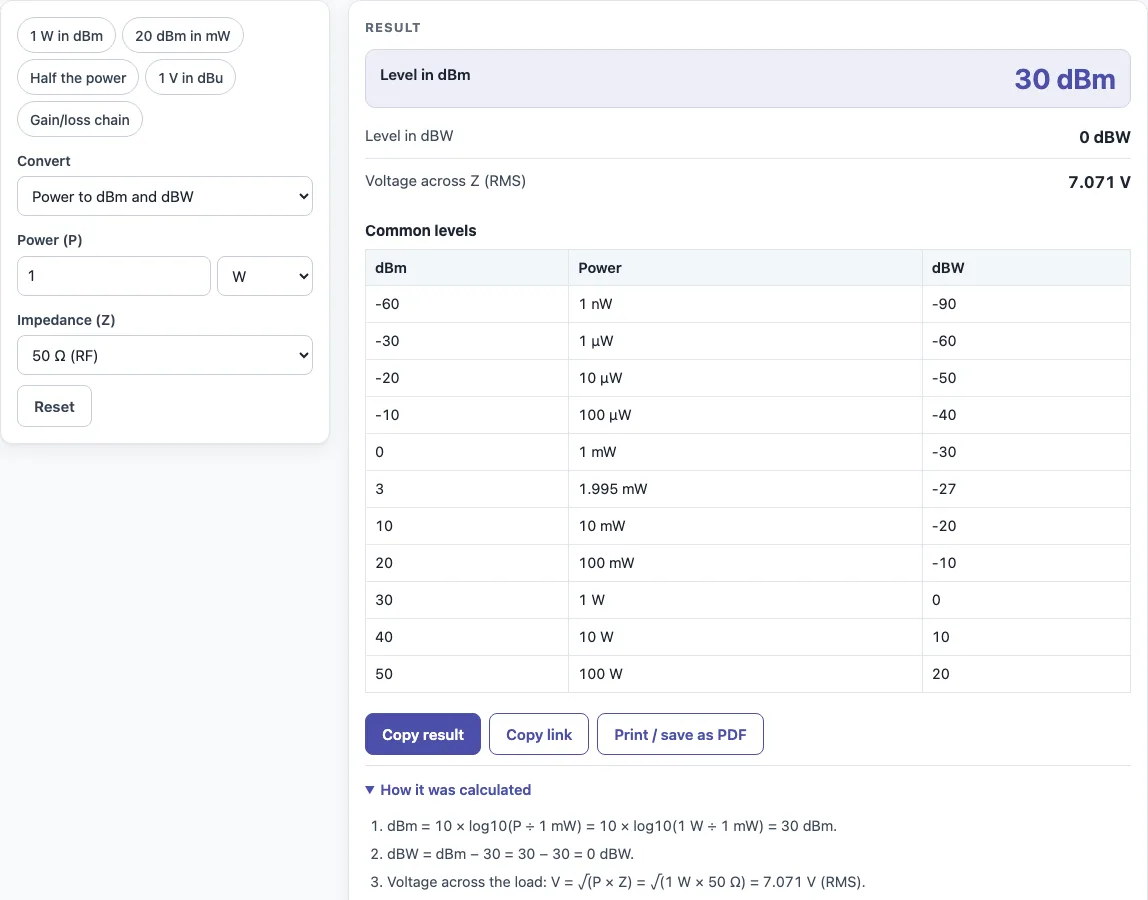
How to use the dBm calculator
- Choose the mode that matches your conversion, such as power to dBm and dBW, or dBm to power and voltage.
- Type your known value into the input for that mode. For voltage modes, also choose the impedance: 50 Ω, 75 Ω, 600 Ω, or a custom value.
- Read the results. They update as you type, so you do not need to submit anything.
- Open “How it was calculated” to see the formula and each step with your numbers.
- For a signal chain, enter each gain or loss in dB, using a minus sign for losses. For example: 0 dBm, −3, +20, −1.5, +10.
When the result is right, Copy result copies the result lines with a link. Copy link copies the page address, which stores every input (in the ?s= part), so opening it later restores the same calculation. Print / save as PDF prints the inputs, results, calculation steps and the date. Everything runs in your browser, nothing is uploaded, and it works on a phone.
The presets show 1 W in dBm, 20 dBm in mW, half the power, 1 V in dBu and a gain/loss chain. In chain mode, type the starting level and then each gain or loss separated by commas, such as 0, −3, +20, −1.5, +10.
Impedance can be 50, 75 or 600 Ω or your own value.
How do you convert dBm to watts?
To convert dBm to watts, use P = 1 mW × 10^(dBm ÷ 10). Divide the dBm value by 10, raise 10 to that power, then multiply by 1 mW. For example, 20 dBm gives 10² × 1 mW = 100 mW, or 0.1 W.
The reverse watts to dBm conversion uses dBm = 10 log10(P ÷ 1 mW), with P in milliwatts. For 1 W, P = 1000 mW, so 10 log10(1000) = 30 dBm. The same power in dBW is 0 dBW, because dBW = dBm − 30.
Voltage across a load is related to power by V = √(P × Z). With Z = 50 Ω and P = 1 mW (0 dBm), V = √(0.001 × 50) ≈ 0.2236 V. This is the step behind any dbm to volt or v to dBm conversion.
What is the difference between dB and dBm?
dB is a ratio that compares two values, while dBm is an absolute level measured against a fixed reference of 1 mW. Because dB only compares, it has no starting point of its own. A gain of 3 dB means the output is about twice the input, whatever the actual power is.
Power ratios use dB = 10 log10(P₂ ÷ P₁). Going from 10 mW to 1 mW gives a ratio of 0.1, so 10 log10(0.1) = −10 dB. Voltage ratios use dB = 20 log10(V₂ ÷ V₁), so a 20 dB change is a tenfold change in voltage.
dBm, dBW, dBV and dBu are absolute levels, because each has a fixed reference: 1 mW for dBm, 1 W for dBW, 1 V for dBV, and 0.7746 V for dBu. This is why a value such as 20 dBm names a specific power, while 20 dB only names a change.
How many dB is double the power?
Doubling the power is +3.01 dB (10 log10 2) and halving it is −3.01 dB. Doubling the voltage across the same impedance is +6.02 dB, because power goes with the square of the voltage. A 10 dB step is ten times the power, and 20 dB ten times the voltage.
Sources
Checked October 2026:
- Wikipedia, Decibel and dBu: dBm = 10 log10(P / 1 mW), dBu reference 0.7746 V, dBV reference 1 V
For estimation; verify critical designs against the applicable standard.
Worked examples
| Input | Result |
|---|---|
| P = 1 W | 30 dBm = 0 dBW |
| 20 dBm | 100 mW |
| P₁ = 10 mW, P₂ = 1 mW | -10 dB |
| V = 1 V, Z = 600 Ω | 0 dBV, 2.218 dBu, 2.218 dBm |
| 0 dBm, -3, +20, -1.5, +10 | 25.5 dBm (354.8 mW) |
| 6 dB | 3.981× power, 1.995× voltage |
Calculated by the tool above with these values.
Frequently asked questions
How do you convert watts to dBm?
Use dBm = 10 log10(P ÷ 1 mW), with P in milliwatts. For 1 W, that is 10 log10(1000) = 30 dBm. Enter the power in the power to dBm mode, and the steps appear under “How it was calculated”.
How many dB is double the power?
About 3 dB. The exact value is 10 log10(2) ≈ 3.01 dB. Each 10 dB multiplies power by ten.
How do you calculate decibels from a power ratio?
Divide the second power by the first, take the base-10 logarithm, and multiply by 10: dB = 10 log10(P₂ ÷ P₁). For a 6 dB change, the power ratio is 3.981×, and the voltage ratio is 1.995×.
What is dBu and dBV?
dBV is referenced to 1 V. dBu is referenced to 0.7746 V, which is the voltage that dissipates 1 mW in 600 Ω. For example, 1 V across 600 Ω is 0 dBV and 2.218 dBu.
How do you convert dBm to volts?
First convert dBm to watts, then use V = √(P × Z) with your impedance. For 0 dBm (1 mW) into 50 Ω, V ≈ 0.2236 V. Choose 50 Ω, 75 Ω, 600 Ω, or a custom impedance in the voltage modes.
Does the calculator upload my numbers?
No. Everything runs in your browser, nothing is uploaded, and no sign-up is needed.
What is 0 dBm in watts?
0 dBm is exactly 1 mW (0.001 W). Across 50 Ω that is 0.2236 V RMS.
Related tools
- Wavelength calculator: use it to find the wavelength of a signal when you know its frequency.
- Op amp gain calculator: use it to work out the voltage gain of an operational amplifier circuit.
- Low pass filter calculator: use it to find the cutoff frequency of a low pass filter.
- Audio crossover calculator: use it to set crossover frequencies for speaker drivers.
- Reactance calculator: use it to find the reactance of a capacitor or inductor at a given frequency.
- All calculators: use it to browse every calculator on the site.