Inductance Calculator (Inductor Formula)
Enter the coil's turns and dimensions to get its inductance, or the number of turns needed for a target inductance.
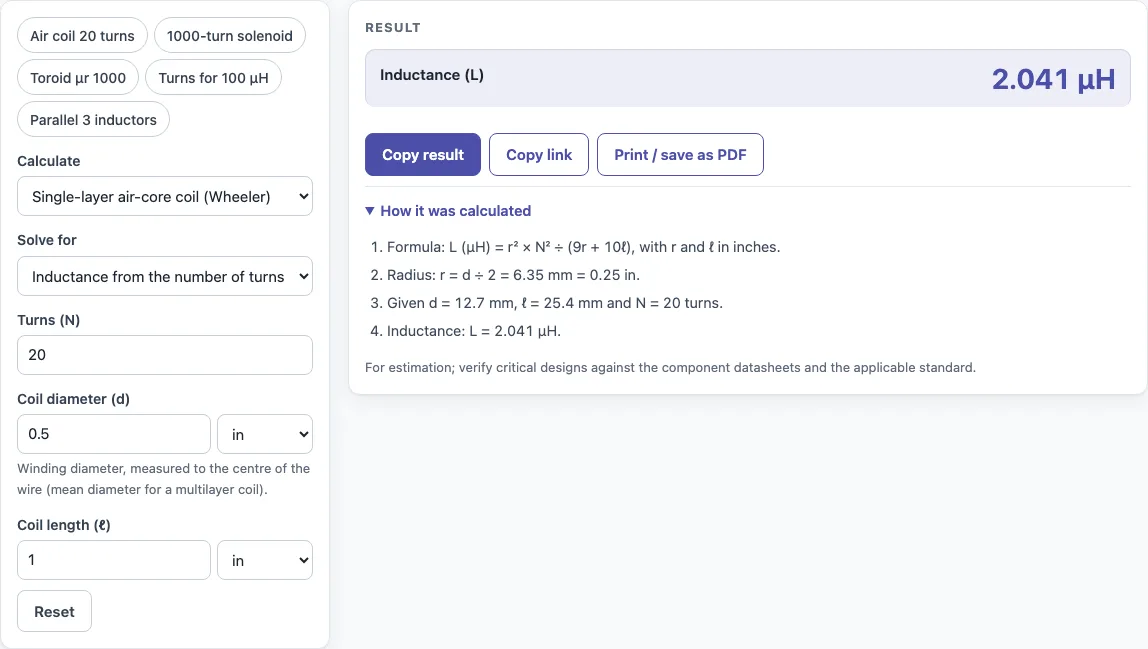
How to use the Inductance Calculator
- Choose the coil type: single-layer air-core, multilayer air-core, long solenoid or toroid.
- Enter the number of turns to find the inductance. To find the turns needed, enter a target inductance instead.
- Enter the coil dimensions in mm or inches. Single-layer coils need the radius and length. Multilayer coils also need the winding depth. Toroids need the outer diameter, inner diameter and height.
- Read the result. It updates as you type. When you solve for turns, the tool shows the exact value and the whole-turn value.
- Open “How it was calculated” to see the formula and each step with your numbers.
- For combined inductors, use the series and parallel section and enter each value.
Copy result copies the result lines with a link back to the page. Copy link copies the page address, which stores every input, so opening it later restores the same calculation. Print / save as PDF prints the inputs, results, calculation steps and the date, which is useful for reports and documentation.
The presets show a 20-turn air coil, a 1000-turn solenoid, a toroid with μr 1000, the turns for 100 µH and three inductors in parallel. Coil dimensions can be entered in mm or inches; the formulas convert them internally.
What is the formula for an inductor?
An inductor’s inductance depends on how many turns it has, how large the coil is, and what fills its centre. For a long solenoid, the formula is L = μ0 μr N² A ÷ ℓ. Here N is the number of turns, A is the cross-sectional area, ℓ is the length, μ0 = 1.25663706127 × 10⁻⁶ H/m (CODATA 2022), and μr is the relative permeability of the core (1 for air).
The key point is that inductance grows with the square of the turns. Doubling the turns gives four times the inductance, not twice as much.
For a toroid with a rectangular cross-section, the formula is L = μ0 μr N² h ln(OD ÷ ID) ÷ (2π), where h is the height and OD and ID are the outer and inner diameters.
How do you calculate the inductance of a coil?
Start by identifying the coil shape, because each shape has its own formula. For a single-layer air-core coil, use Wheeler’s formula: L (µH) = r² N² ÷ (9r + 10ℓ), where r is the coil radius and ℓ is the coil length, both in inches. This gives a result about 1 % accurate when ℓ is greater than 0.8 r.
For a multilayer air-core coil, Wheeler’s multilayer form is L (µH) = 0.8 r² N² ÷ (6r + 9ℓ + 10b), where b is the winding depth.
To find the turns for a target inductance, rearrange the same formula for N. Because L depends on N², the required turns rise with the square root of the target. On the preset single-layer coil, 100 µH needs about 99 turns (98.99 before rounding). A 20-turn coil gives 2.041 µH, and a 50-turn coil gives 12.76 µH.
How do you combine inductors in series and parallel?
Without magnetic coupling between them, inductors combine like resistors: in series the values add, and in parallel 1/L = 1/L1 + 1/L2 + …. For 100 µH, 220 µH and 47 µH in parallel the total is 27.9 µH. Coupled coils (on the same core, or close together) need the mutual inductance, which this tool does not include.
Sources
Checked October 2026:
- Wikipedia, Inductance: L = μ0 μr N² A / ℓ for a long solenoid
- Wikipedia, Inductor: Wheeler’s multilayer coil formula
- NIST CODATA 2022, μ0 = 1.25663706127 × 10⁻⁶ H/m
- Toroid L = μ0 μr N² h ln(OD/ID) / (2π) from Ampère’s law (rectangular cross-section)
For estimation; verify critical designs against the applicable standard.
Worked examples
| Input | Result |
|---|---|
| single-layer coil: N = 20 | L = 2.041 µH |
| single-layer coil: N = 50 | L = 12.76 µH |
| long solenoid: N = 1000 | L = 3.948 mH |
| toroid: N = 100 | L = 6.931 mH |
| single-layer coil: L = 100 µH | N = 98.99 |
| 100µH, 220µH, 47µH | parallel total 27.92 µH |
Calculated by the tool above with these values.
Frequently asked questions
How many turns for a given inductance?
Enter your target inductance and the tool solves for the number of turns, showing both the exact value and the whole-turn value. On the preset single-layer coil, 100 µH needs about 99 turns.
What is Wheeler’s formula?
Wheeler’s formula is an approximation for air-core coils. For a single layer, L (µH) = r² N² ÷ (9r + 10ℓ), with r and ℓ in inches. It is about 1 % accurate when ℓ is greater than 0.8 r.
How do you calculate the inductance of a toroid?
Use L = μ0 μr N² h ln(OD ÷ ID) ÷ (2π) for a toroid with a rectangular cross-section. On the preset example, a 100-turn toroid with μr 1000 gives 6.93 mH.
How do you combine inductors in series and parallel?
Inductors in series add directly: L total = L1 + L2 + … In parallel, use 1/L = Σ 1/Li. For example, 100 µH, 220 µH and 47 µH in parallel give 27.92 µH. These rules assume the inductors do not couple magnetically.
Does doubling the turns double the inductance?
No. Inductance grows with the square of the turns, so doubling the turns gives four times the inductance.
Why does my measured inductance differ from the calculated value?
The formulas are approximations, so a finished coil can differ from the result. Measure the coil with an LCR meter to get an exact value.
Related tools
- Reactance calculator: use it to find how much an inductor or capacitor opposes AC current at a given frequency.
- Low pass filter calculator: use it to size a filter’s cutoff frequency from its component values.
- Audio crossover calculator: use it to choose component values for splitting audio signals between speaker drivers.
- RC time constant calculator: use it when you need a timing value from a resistor and capacitor instead of an inductor.
- Wavelength calculator: use it to convert between frequency and wavelength for a signal in your circuit.
- All calculators: use it to browse every tool on the site.