Motor Torque Calculator
Enter motor power and speed to get the torque in N·m and lb·ft, or work back from torque, current or a gearbox ratio.
The motor torque calculator converts motor power and speed into torque (T = 9549 × kW ÷ rpm, or 5252 × hp ÷ rpm), and it can also work out torque from a motor’s voltage and current. Enter your numbers and the result appears as you type, in N·m, lb·ft, lb·in and kgf·m. The tool runs in your browser, is free, and needs no sign-up. It also works on a phone.
It also adds a gearbox: enter the ratio and efficiency to get the output torque and speed. Use it to check a motor against a load, to size a coupling or a gearbox, or to read the full-load torque from a nameplate’s kW or hp and rpm.
How to use the Motor torque calculator
- Choose a mode: torque from power and speed, power from torque and speed, or torque from voltage and current.
- For torque from power and speed, enter the power in kW or hp and the speed in rpm.
- For power from torque and speed, enter the torque and the speed. Pick the torque unit you have, such as N·m or lb·ft.
- For torque from voltage and current, enter the voltage and current, then select three-phase or single-phase. Add the power factor (PF) and the efficiency (η).
- Optional: enter a gearbox ratio and gearbox efficiency to see the output torque and output speed after the gearbox.
- Read the results. Torque appears in N·m, lb·ft, lb·in and kgf·m, and power appears in kW and hp.
- Open “How it was calculated” to see the formula and each step with your numbers.
Use Copy result to copy the result lines with a link. Use Copy link to copy the page address, which stores all your inputs, so opening it later restores the same calculation. Print / save as PDF prints the inputs, results, calculation steps and the date.
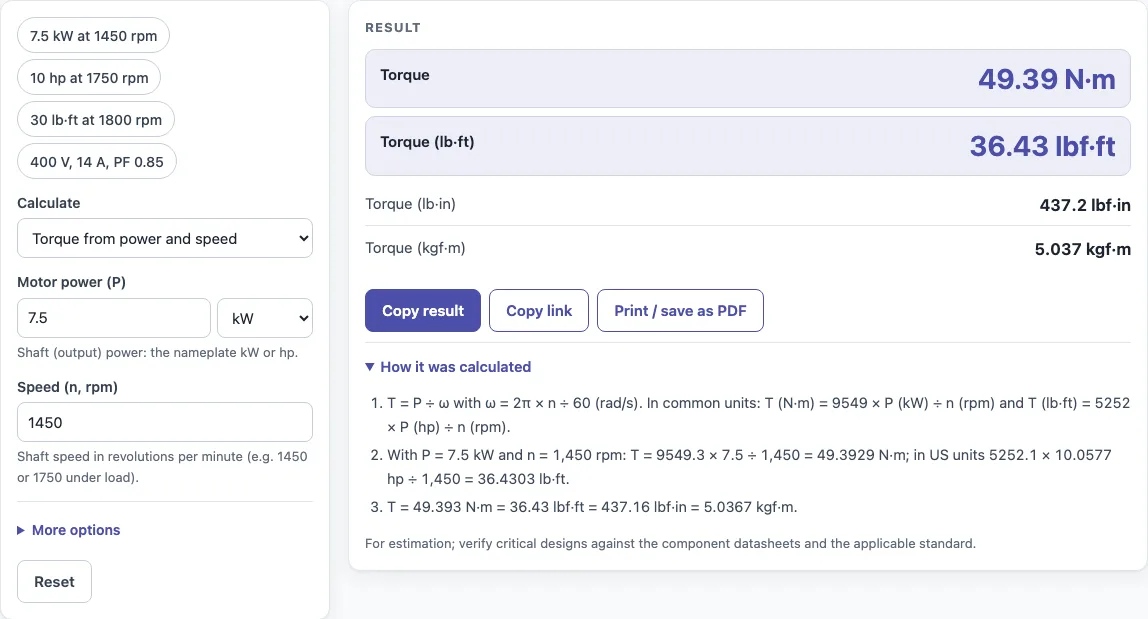
The presets show 7.5 kW at 1450 rpm, 10 hp at 1750 rpm, 30 lb·ft at 1800 rpm and a 400 V motor drawing 14 A.
How do you calculate motor torque from kW and rpm?
Use T (N·m) = 9549 × P (kW) ÷ n (rpm). The constant 9549 is 60,000 ÷ 2π rounded (9549.3; the tool uses the exact value), which converts the power in kilowatts and the speed in revolutions per minute into torque in newton-metres. For example, a 7.5 kW motor at 1450 rpm gives 9549 × 7.5 ÷ 1450 = 49.4 N·m.
To go the other way, use P = T × n ÷ 9549. Torque and speed trade off at the same power: a 2-pole motor gives about half the torque of a 4-pole motor of the same power, because it runs at about twice the speed.
What is the torque formula for horsepower and rpm?
Use T (lb·ft) = 5252 × hp ÷ rpm. For example, 10 hp at 1750 rpm gives 5252 × 10 ÷ 1750 = 30.0 lb·ft, which is 40.7 N·m. One horsepower is 745.7 W, so you can also convert hp to kW before using the metric formula.
For the reverse, 30 lb·ft at 1800 rpm gives about 7.67 kW (10.3 hp). Convert lb·ft to N·m first, because the power formula uses N·m.
What is 5252 in the torque formula?
The number 5252 is 33,000 ÷ 2π, rounded. One horsepower is defined as 33,000 foot-pounds of work per minute. Dividing by 2π converts that work rate into torque per revolution per minute, so the formula gives torque in pound-feet directly from horsepower and rpm.
How do you calculate torque from motor current?
First find the electrical output power, then use the power and speed to find torque. For a three-phase motor, output power = √3 × V × I × PF × η. For a single-phase motor, leave out the √3 and use V × I × PF × η.
For example, a three-phase motor on 400 V drawing 14 A, with PF 0.85 and efficiency 90 %, delivers about 7.42 kW. At 1450 rpm, that gives 48.9 N·m.
How does a gearbox change torque?
A gearbox trades speed for torque. Output torque = motor torque × ratio × gearbox efficiency, and output speed = motor speed ÷ ratio. A 20:1 gearbox on a 0.75 kW motor at 1400 rpm turns 5.12 N·m of motor torque into 92.08 N·m at 70 rpm, with a 90 % gearbox efficiency.
Efficiency losses mean the output torque is always a little lower than the ratio alone would suggest.
Sources
Checked October 2026:
- Wikipedia, Horsepower and NIST SP 811 appendix B.8: 1 hp = 745.69987 W
- T = P ÷ ω with ω = 2πn/60, giving 9549.3 × kW ÷ rpm and 5252 × hp ÷ rpm (derived)
For estimation; verify critical designs against the applicable standard.
Worked examples
| Input | Result |
|---|---|
| 7.5 kW at 1450 rpm | 49.39 N·m (36.43 lbf·ft) |
| 10 hp at 1750 rpm | 40.69 N·m (30.01 lbf·ft) |
| 30 lbf·ft at 1800 rpm | 7.667 kW (10.28 hp) |
| 400 V, 14 A, PF 0.85, η 90 %, 1450 rpm | 48.87 N·m |
| 0.75 kW at 1400 rpm | 5.116 N·m (3.773 lbf·ft), gearbox output 92.08 N·m at 70 rpm |
Calculated by the tool above with these values.
Frequently asked questions
What is the motor torque equation for kW and rpm?
The equation is T (N·m) = 9549 × P (kW) ÷ n (rpm). Enter power and speed in the tool’s first mode to get the result instantly.
Is nameplate torque the same as starting torque?
No. Nameplate full-load torque assumes rated power at rated speed. Starting and breakdown torque are listed on the motor maker’s data sheet.
Does the calculator work on a phone?
Yes. It runs entirely in your browser, so it works on a phone as well as a computer. Nothing is uploaded.
Can I use the results in commercial work?
Yes. You can use the results in designs, quotes, documentation and reports without attribution.
How much torque does a 1 hp motor have?
At 1750 rpm, 1 hp gives 5252 ÷ 1750 = 3.0 lb·ft (4.07 N·m); at 3450 rpm it gives about 1.52 lb·ft.
Does more poles mean more torque?
For the same power, yes: a 4-pole motor runs at about half the speed of a 2-pole motor, so it gives about twice the torque.
How do I convert N·m to lb·ft?
Multiply N·m by 0.7376 (1 lb·ft = 1.3558 N·m). The tool shows both, plus lb·in and kgf·m.
Can I calculate torque for a single-phase motor?
Yes. Choose single-phase in the voltage and current mode; the √3 factor is left out.
Related tools
- Synchronous speed calculator: use it to find the rpm of a motor from its supply frequency and pole count before calculating torque.
- Linear actuator calculator: use it when your motor drives a linear motion instead of a rotating shaft.
- Stepper motor calculator: use it for steps, pulse rate and speed of a stepper drive.
- PLC simulator: use it to test control logic before connecting a motor drive to a PLC.
- 4-20 mA calculator: use it to scale analog signals that set a motor’s speed or load.
- NEMA enclosure rating chart: use it to choose a motor enclosure for the environment it will run in.
- All calculators: use it to browse every calculator on the site.