Op Amp Gain Calculator
Choose the amplifier configuration and enter the resistors to get the gain in V/V and dB and the output for your input voltage.
The Op Amp Gain Calculator finds the gain of an operational amplifier circuit from its resistor values. Choose a configuration and enter the resistors, and it returns the gain in V/V and dB along with the output voltage for your input. It covers inverting, non-inverting, voltage follower, differential and summing amplifiers, so you can check the gain formula for each type in one place.
The tool also draws a schematic and limits the output to the supply rails you enter, so you can see what the circuit can realistically deliver. It runs in your browser, is free, needs no sign-up, and works on a phone. Use it when you are designing an amplifier stage, checking a homework answer, or documenting a circuit.
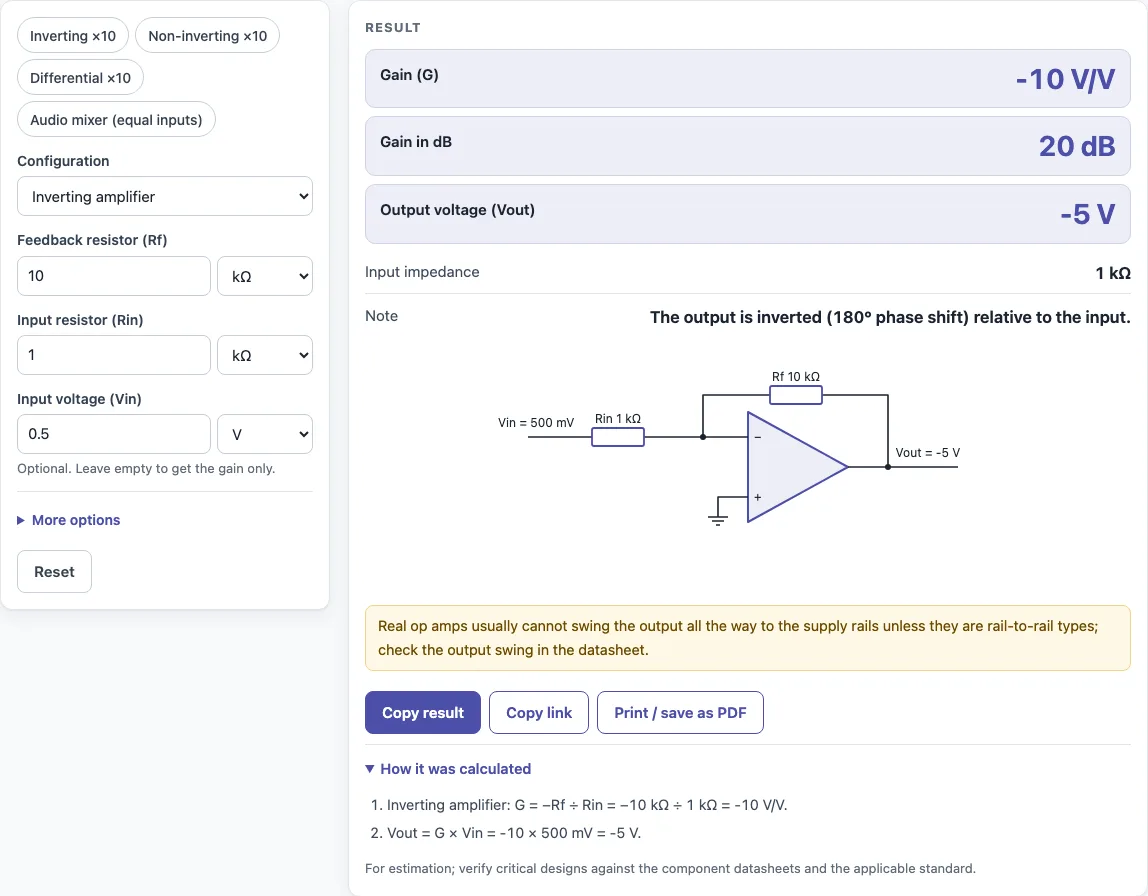
How to use the Op Amp Gain Calculator
- Choose the amplifier configuration: inverting, non-inverting, voltage follower, differential or summing.
- Enter the feedback resistor Rf and the input resistor. For an inverting amplifier this is Rin, for a non-inverting amplifier it is Rg. A differential amplifier uses R1 and R2, and a summing amplifier needs one resistor for each input.
- Enter the input voltage Vin. For a differential amplifier, enter V1 and V2. For a summing amplifier, enter one voltage for each input. Leave the input voltage empty if you only want the gain.
- Enter the supply voltage ±Vcc. The output is clipped to these rails.
- Read the results: gain in V/V and dB, the output voltage after clipping, the ideal unclipped output, the input impedance, and the schematic.
- Open “How it was calculated” to see the formula and each step with your numbers.
Results update as you type, so change any value and watch the output change. Copy result copies the result lines with a link. Copy link copies the page address, which stores every input, so opening it later restores the same calculation. Print / save as PDF prints the inputs, results, calculation steps and the date.
The presets show ×10 inverting, non-inverting and differential amplifiers and an audio mixer.
What is the gain formula for an inverting op amp?
For an inverting op amp, the gain is G = −Rf ÷ Rin. The input signal goes through Rin into the inverting input, and Rf feeds the output back to that same input. The minus sign means the output is inverted, so a positive input gives a negative output.
For example, with Rf = 10 kΩ and Rin = 1 kΩ, the gain is −10 V/V (20 dB). An input of 0.5 V gives an output of −5 V. The input impedance of this circuit is equal to Rin.
What is the gain of a non-inverting amplifier?
The gain of a non-inverting amplifier is G = 1 + Rf ÷ Rg. The input goes straight to the non-inverting input, and the output is not inverted. Because the “1 +” is always there, the gain can never be less than 1.
With Rf = 90 kΩ and Rg = 10 kΩ, the gain is 10 V/V, so a 100 mV input gives 1 V. A voltage follower is a special case with G = 1, where the output is connected straight back to the inverting input.
How do you calculate op amp gain in dB?
Convert the voltage gain to decibels with dB = 20 × log10|G|. Use the absolute value of G, so the minus sign of an inverting amplifier does not affect the result.
A gain of 10 V/V is 20 dB, since log10(10) = 1. A gain of 101 V/V is about 40.09 dB. Each tenfold increase in voltage gain adds 20 dB.
How does a differential amplifier work?
A differential amplifier outputs a voltage proportional to the difference between its two inputs. The formula is Vout = (R2 ÷ R1)(V2 − V1), and it works correctly only when the resistor pairs are matched.
With R1 = 10 kΩ, R2 = 100 kΩ, V1 = 1 V and V2 = 1.2 V, the gain is 10 and the output is 2 V. Any voltage common to both inputs, such as noise shared by both wires, is rejected. The input impedance is 2 × R1.
How does a summing amplifier work?
A summing amplifier adds several input voltages, each multiplied by its own weight. The inverting form is Vout = −Rf (V1/R1 + V2/R2 + V3/R3). Each input contributes through its own resistor, so a smaller resistor gives that input more weight.
With Rf = 10 kΩ, R1 = 10 kΩ, R2 = 20 kΩ, V1 = 1 V and V2 = 2 V, the output is −(1 + 1) = −2 V. The output is inverted, as in the inverting amplifier.
Sources
Checked October 2026:
- Wikipedia, Operational amplifier applications: inverting, non-inverting, follower, difference and summing amplifiers (ideal op amp)
For estimation; verify critical designs against the applicable standard.
Worked examples
| Input | Result |
|---|---|
| Inverting: Rf = 10 kΩ, Rin = 1 kΩ, Vin = 0.5 V | G = -10 V/V (20 dB), V out = -5 V |
| Non-inverting: Rf = 90 kΩ, Rg = 10 kΩ, Vin = 100 mV | G = 10 V/V (20 dB), V out = 1 V |
| Non-inverting: Rf = 100 kΩ, Rg = 1 kΩ, Vin = 0.5 V | G = 101 V/V (40.09 dB), V out = 12 V |
| Differential: R1 = 10 kΩ, R2 = 100 kΩ, V1 = 1 V, V2 = 1.2 V | G = 10 V/V, V out = 2 V |
| Summing: Rf = 10 kΩ, R1 = 10 kΩ, R2 = 20 kΩ, V1 = 1 V, V2 = 2 V | V out = -2 V |
Calculated by the tool above with these values.
Frequently asked questions
Can I get the gain without entering an input voltage?
Yes. Leave the input voltage empty and the tool shows the gain in V/V and dB only. This is useful when you are choosing resistor values before you know the signal level.
Why is my output voltage smaller than the ideal output?
The tool limits the output to the supply rails ±Vcc you enter, and the “ideal” line shows the value before that limit. Real op amps usually cannot swing all the way to the rails unless they are rail-to-rail types, and the tool notes it when clipping happens.
Is a negative gain a problem?
No. A negative gain in V/V means the inverting amplifier flips the signal’s polarity. The dB value uses the absolute value, so it is always shown as a positive number.
Can I use the results in commercial work?
Yes. Results may be used in designs, quotes, documentation and reports without attribution.
Do I need to install anything or create an account?
No. The calculator runs in your browser, is free, needs no sign-up, and works on a phone.
What is the input impedance of a non-inverting amplifier?
Very high: it is the op amp’s own input impedance, which is why a non-inverting stage or a voltage follower is used as a buffer.
Related tools
- Voltage divider calculator: use it to find the resistor ratio that sets a fixed fraction of a voltage for an op amp input.
- Low pass filter calculator: use it to size the resistor and capacitor for a filter stage built around an op amp.
- Decibel calculator: use it to convert other power or voltage ratios to and from dB.
- 555 timer calculator: use it when you need timing values for a 555 timer circuit.
- 4-20 mA calculator: use it to convert between current and process values in 4-20 mA loops.
- All calculators: use it to browse every calculator on the site.