Parallel Resistor Calculator
List your resistor values to get the total resistance in parallel and in series, the current in each, and a standard pair for a target.
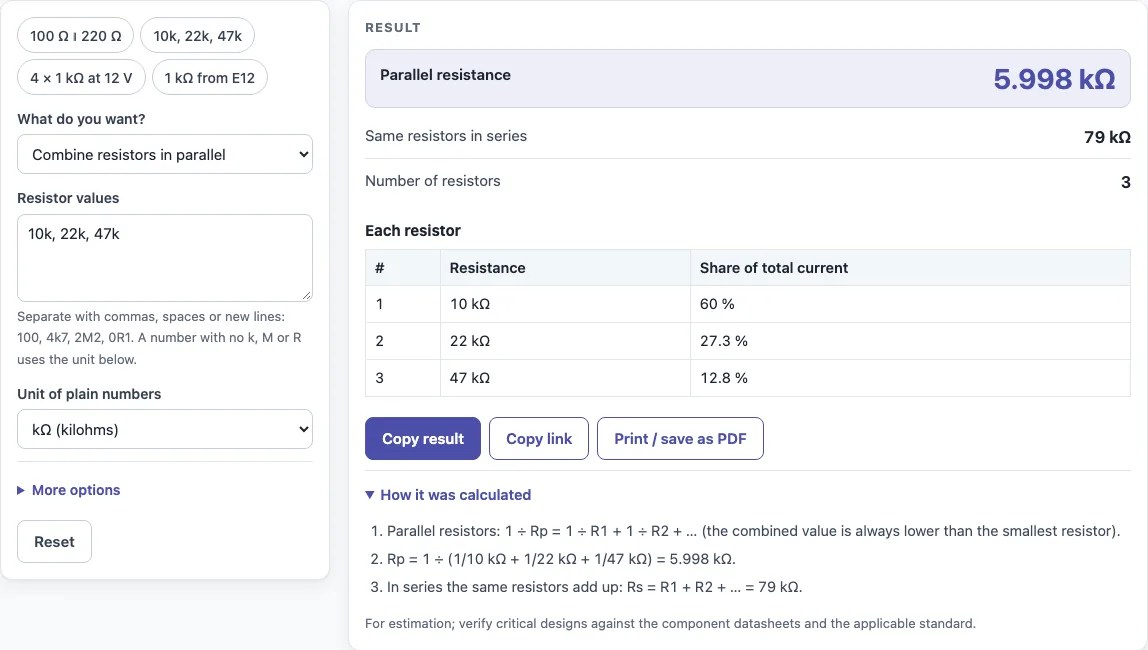
The parallel resistor calculator finds the total resistance of two or more resistors connected in parallel. Type your values into one box, and the total updates as you type, next to the series total for comparison. It also shows each resistor’s share of the total, and with a voltage or total current it adds the current and power in each branch.
The tool runs in your browser. It is free, needs no sign-up, and works on a phone. It accepts schematic-style values such as 4k7 or 2M2, so you can enter parts exactly as they are labelled.
It is a quick parallel resistor cal for any number of values.
How to use the Parallel resistor calculator
- Type your resistor values into the input box, separated by spaces or commas. For example, enter
4k7 2k2 680or100, 220. - Use the unit select to set the unit for plain numbers: Ω, kΩ or MΩ. Values with a letter, such as 4k7, already include their unit.
- Read the parallel total in the results. There is no calculate button, because the results update as you type.
- Check the table, which shows each resistor’s share of the total.
- Optionally, enter a voltage or a total current. The tool then shows the current and power in each branch.
- To find two standard resistors that come close to a target value, switch to pair mode. It lists the top five combinations from the E6 to E96 series.
- Click Copy result to copy the result lines with a link, or Copy link to copy the page address.
- Click Print / save as PDF to keep a record of your inputs, results, calculation steps and the date.
The “How it was calculated” section lists the formula and each step using your numbers, so you can check the working. The page address stores every input (the ?s= part), so opening that link later restores the same calculation.
How do you calculate resistors in parallel?
Add the reciprocal of each resistance, then take the reciprocal of that sum. The rule is 1/R = 1/R1 + 1/R2 + …, where R is the total resistance. Each added branch gives current another path, so the total is always lower than the smallest resistor in the group.
For 100 Ω in parallel with 220 Ω, 1/100 + 1/220 = 0.014545. The reciprocal of that is 68.75 Ω, so 100 Ω ∥ 220 Ω = 68.75 Ω. The symbol ∥ means “in parallel with.”
What is the formula for two resistors in parallel?
For two resistors, the formula is R = R1 × R2 ÷ (R1 + R2). This is the product divided by the sum, so you can skip the reciprocal steps. Both values must use the same unit before you start.
For 10 kΩ and 47 kΩ, the calculation is 10 × 47 ÷ (10 + 47) = 470 ÷ 57 ≈ 8.25 kΩ.
What is the total resistance of resistors in series and parallel?
In series, resistances add directly: R = R1 + R2 + …. In parallel, use the reciprocal rule instead. A mixed circuit is solved one group at a time. Reduce each parallel group to a single equivalent resistor, then add the results that are connected in series.
The calculator shows both totals for the same list. For 10 kΩ, 22 kΩ and 47 kΩ, the parallel total is 5.998 kΩ and the series total is 79 kΩ. For 4k7, 2k2 and 680 Ω, the parallel total is 467.7 Ω and the series total is 7.58 kΩ.
How do I make a resistor value from two standard resistors?
Choose one standard resistor R1 that is larger than your target R. Then calculate the partner as R2 = R × R1 ÷ (R1 − R). Pick the nearest standard value, then check the result with the calculator.
If you want a value that is not in your parts bin, pair mode does this search for you. It checks standard E6 to E96 values and ranks the best combinations. For a target of 1 kΩ using the E12 series, the example result is 1 kΩ ∥ 1 MΩ = 999 Ω.
How is current divided between parallel resistors?
Each parallel branch has the same voltage across it, so each branch current is I = V ÷ R. The branch currents add up to the total current. A smaller resistor receives more current, and a resistor half the value receives twice the current.
For a 12 V supply across 100 Ω and 220 Ω, the currents are 0.12 A and 0.0545 A. Together they make 0.1745 A, which matches 12 ÷ 68.75. The power in each branch is P = V² ÷ R, which gives 1.44 W in the 100 Ω branch and 0.65 W in the 220 Ω branch.
What is the parallel resistor equation for finding resistance in a parallel circuit?
The parallel resistor equation is 1/R = 1/R1 + 1/R2 + …; finding resistance in a parallel circuit means adding the conductances (1/R) and inverting the sum. When calculating resistors in parallel and series together, reduce each parallel group first, then add the series parts — calculating resistance in series and parallel circuits always works from the innermost group outward.
Sources
Checked October 2026:
- Wikipedia, Current divider for parallel resistance and current sharing
- Wikipedia, E series of preferred numbers and the Vishay decade table for E6–E96
For estimation; verify critical designs against the applicable standard.
Worked examples
| Input | Result |
|---|---|
| 10k, 22k, 47k | 5.998 kΩ (79 kΩ in series) |
| 100, 220 | 68.75 Ω (320 Ω in series) |
| 1k, 1k, 1k, 1k | 250 Ω (4 kΩ in series) |
| 4k7 2k2 680 | 467.7 Ω (7.58 kΩ in series) |
| 1 kΩ, E12 | 1 kΩ ∥ 1 MΩ = 999 Ω |
Calculated by the tool above with these values.
Frequently asked questions
Can the parallel total be higher than the smallest resistor?
No. Adding a resistor in parallel always lowers the total, so the result is always less than the smallest value in the group.
What is the parallel total of equal resistors?
Divide the value of one resistor by the number of resistors. For example, four 1 kΩ resistors in parallel give 250 Ω.
Do I need a voltage to get the total resistance?
No. The total resistance depends only on the resistor values. A voltage or total current is needed only to find the current and power in each branch.
How do I enter values like 4.7 kΩ or 2.2 MΩ?
Use the R, k and M notation found on schematics. For example, 4k7 is 4.7 kΩ, 470R is 470 Ω, 2M2 is 2.2 MΩ, and 0R1 is 0.1 Ω.
Can the calculator show series totals too?
Yes. Along with the parallel total, the results show the series total, which is the simple sum of all the values you entered.
Can I use the results in commercial work?
Yes. You may use the results in designs, quotes, documentation and reports without attribution.
What is the resistance of two equal resistors in parallel?
Half of one: two 1 kΩ resistors in parallel give 500 Ω, and four give 250 Ω.
Related tools
- Voltage divider calculator: use it to find output voltage when two resistors share a supply.
- Resistor color code calculator: use it to read a resistor’s value from its colour bands.
- Capacitor series parallel calculator: use it for capacitors, which combine in the opposite way to resistors.
- LED resistor calculator: use it to choose a series resistor for an LED.
- PCB trace width calculator: use it to size circuit board traces for the current they carry.
- All calculators: use it to browse every tool on the site.