Pneumatic Cylinder Force Calculator
Enter the bore, rod diameter and air pressure to get the force on the extend and retract strokes.
This pneumatic cylinder force calculator gives the push and pull force of an air cylinder from three numbers: the bore, the rod diameter and the air pressure. It works as an air cylinder force calculator in metric or imperial units, with the result in newtons, pounds-force and kilograms-force. The extend force and the retract force are shown side by side, because a double-acting cylinder pulls with less force than it pushes.
The calculator is free and runs in your browser. Nothing is uploaded, and there is no sign-up. It gives the theoretical force from pressure and area; you can deduct a percentage for friction and seal losses if you know it. Use it to check that a cylinder can move a load before you choose it from a catalogue.
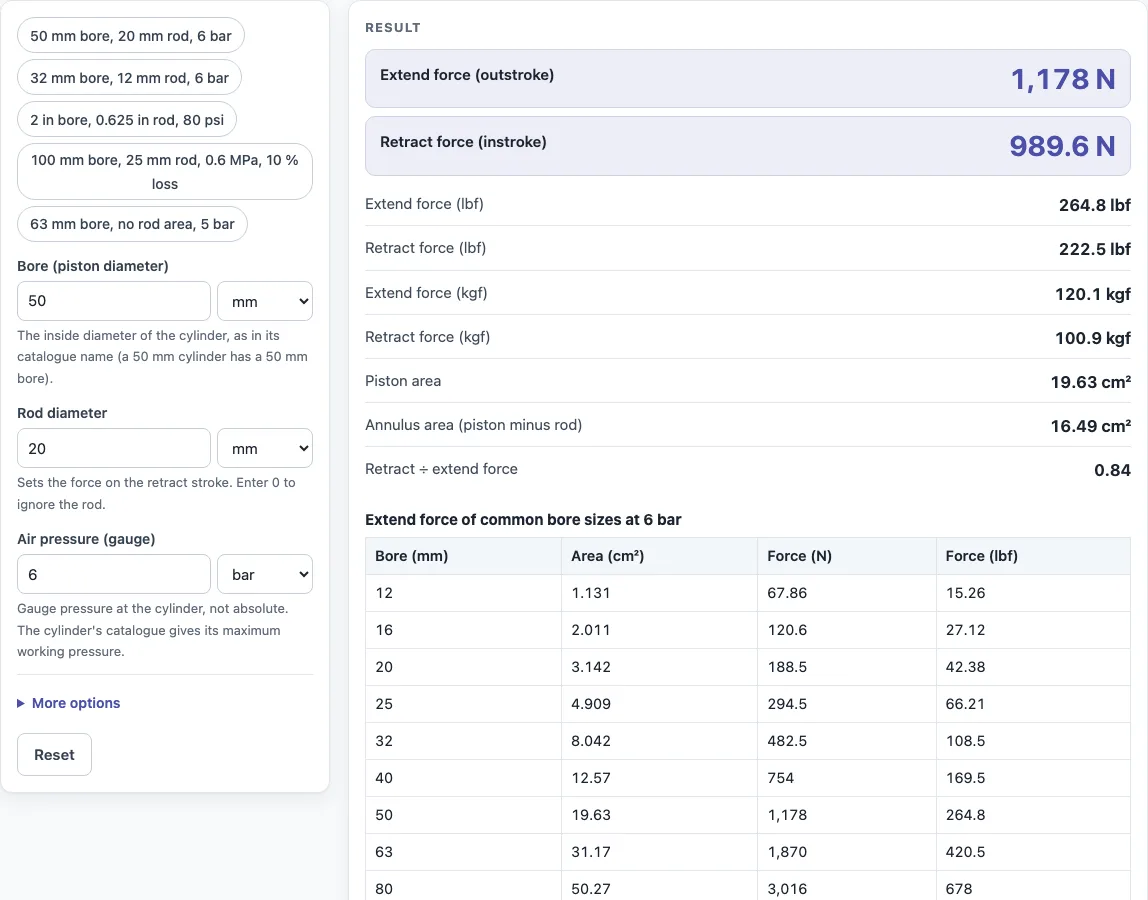
How to use the pneumatic cylinder force calculator
- Type the Bore (piston diameter) and choose mm or in. This is the cylinder size in its catalogue name.
- Type the Rod diameter in the same way. Enter 0 to ignore the rod.
- Type the Air pressure (gauge) and choose bar, psi, kPa or MPa.
- Optional: open More options and enter Friction and seal losses (%) to deduct that share from both forces.
- Read Extend force (outstroke) and Retract force (instroke). The rows below repeat them in lbf and kgf, and show the Piston area, the Annulus area (piston minus rod) and the Retract ÷ extend force ratio.
- Open How it was calculated to see each step with your numbers. The table under the result lists the extend force of common bore sizes at your pressure.
The example buttons above the form, such as 50 mm bore, 20 mm rod at 6 bar, fill in a finished case. Copy result, Copy link and Print / save as PDF sit under the result. Copy link stores every input in the page address, so the same calculation reopens later, and Reset returns the form to its starting values. Change one field at a time to see how the force depends on it: doubling the bore quadruples the area, while doubling the pressure only doubles the force.
How do you calculate pneumatic cylinder force?
Force equals pressure times the area it acts on: F = P × A. On the extend stroke, air pushes on the full piston, so A = π × D² ÷ 4 with D the bore. On the retract stroke, the rod takes up part of the area, so A = π × (D² − d²) ÷ 4, with d the rod diameter. Wikipedia’s article on the pneumatic cylinder gives the same expressions and notes that the instroke force is less than the outstroke force.
What is the force of a 50 mm cylinder at 6 bar?
A 50 mm bore has a piston area of 19.635 cm². At 6 bar (0.6 N/mm²) the extend force is 1,178 N, about 120 kgf or 265 lbf. With a 20 mm rod the annulus area is 16.493 cm², so the retract force is 990 N. The retract force is about 84 % of the extend force.
Which pressure should I use?
Use gauge pressure at the cylinder itself, not at the compressor. Pressure drops along hoses and through valves and fittings, so the pressure at the cylinder while it moves can be lower than the regulator setting. The cylinder’s catalogue gives its maximum working pressure, and the force table in the catalogue can be compared with this calculator.
How do I convert the force to kg or lbf?
The calculator does it for you. One kilogram-force is 9.80665 N and one pound-force is 4.44822 N. A force of 1,178 N is therefore 120.1 kgf or 264.9 lbf.
How much force is lost to friction?
Friction depends on the seals, the lubrication and the speed, so there is no single figure. If you know the efficiency from the cylinder maker, enter the loss under More options and both forces fall by that percentage. Leave it at 0 for the theoretical force, and choose the cylinder with a safety margin over the load.
Worked examples
| Input | Result |
|---|---|
| 50 mm bore, 20 mm rod, 6 bar | 1,178 N out, 989.6 N in |
| 32 mm bore, 12 mm rod, 6 bar | 482.5 N out, 414.7 N in |
| 2 in bore, 0.625 in rod, 80 psi | 1,118 N out, 1,009 N in |
| 100 mm bore, 25 mm rod, 0.6 MPa, 10 % loss | 4,241 N out, 3,976 N in |
| 63 mm bore, 0 mm rod, 5 bar | 1,559 N out, 1,559 N in |
Calculated by the tool above with these values.
Frequently asked questions
Is the retract force always lower than the extend force?
For a double-acting cylinder with the same pressure on both sides, yes, because the rod takes up part of the piston area on the retract side. The calculator shows the ratio of the two forces.
What if my cylinder is single-acting?
A single-acting cylinder has one air port. Its working stroke uses the full piston area, so the extend force is the one to read. The return is by spring, and the spring force reduces the net force, so subtract it yourself.
Can I enter the bore in inches and the pressure in bar?
Yes. Each field has its own unit list, so mix them freely. For example, a 2 in bore at 80 psi gives 251.3 lbf on the extend stroke.
Why does the calculator warn above 16 bar?
Above 16 bar is a very high pneumatic pressure. The calculator still shows the result, but check the cylinder’s rated maximum pressure before using it.
Does the force depend on the stroke length?
No. The force depends only on the pressure and the area. The stroke length affects the volume of air used and the time to move, not the force.
Related tools
- Linear actuator calculator: use it to size an electric actuator for the same load.
- Motor torque calculator: use it to find the shaft torque of a motor.
- PLC simulator: use it to try the ladder logic that switches the valve.
- 4-20 mA scaling calculator: use it to scale a pressure transmitter signal.
- Stepper motor calculator: use it for steps and speed of a stepper drive.
- All calculators: use it to browse every tool on the site.
Sources
- Pneumatic cylinder (Wikipedia): outstroke force F = P × πr², instroke force F = P × π(r1² − r2²), instroke force lower than outstroke force
- Conversions: 1 kgf = 9.80665 N (standard gravity), 1 lbf = 4.4482216 N