RC Time Constant Calculator
Enter the resistor and capacitor to get the time constant, the charge curve and how long the capacitor takes to reach a voltage.
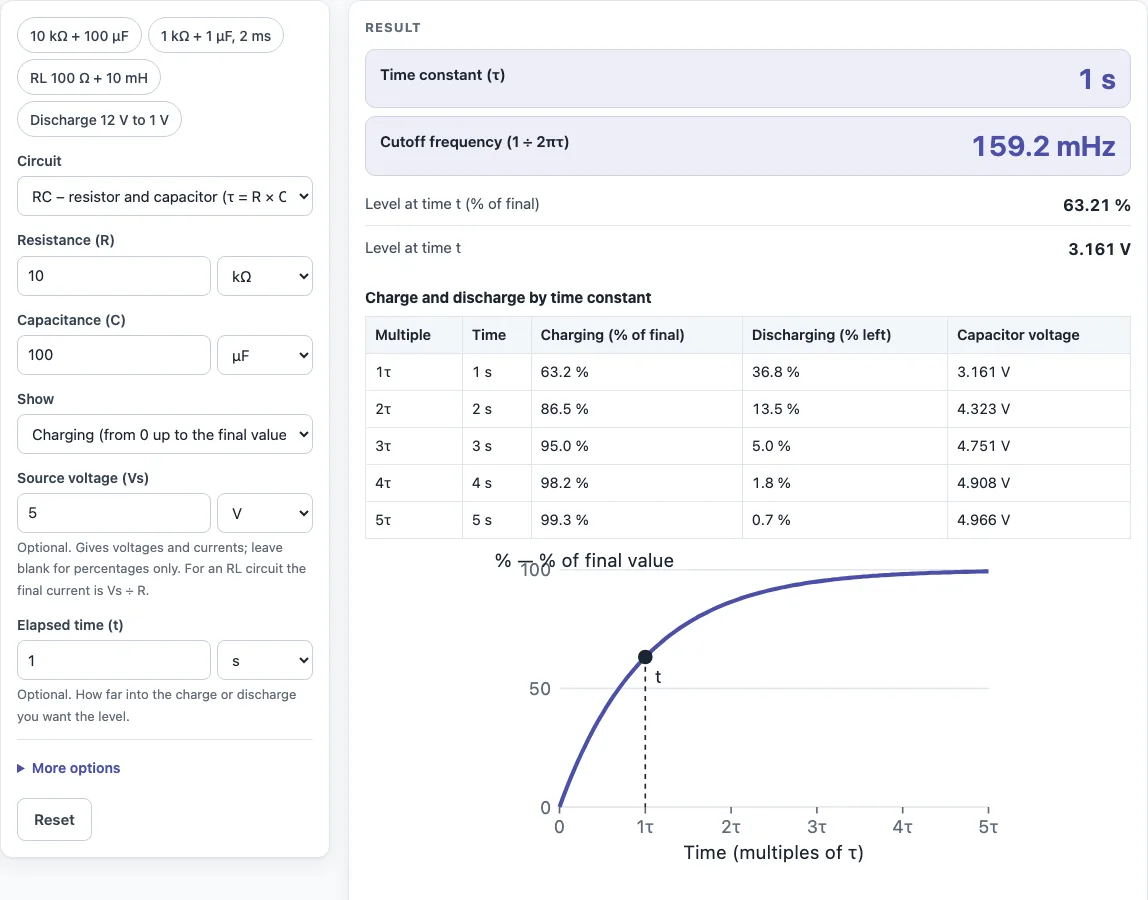
How to use the RC time constant calculator
- Choose whether you are working with an RC circuit (resistor and capacitor) or an RL circuit (resistor and inductor).
- Enter the resistance R. Prefixes are fine, for example 10 kΩ or 4.7 kΩ.
- Enter the capacitance C, such as 100 µF or 10 nF, or the inductance L, such as 10 mH.
- Enter a time t to see the voltage (or current) at that moment. Enter a target voltage (or current) to find the time needed to reach it.
- Read the results: the time constant τ, the cutoff frequency fc, the level after time t, and the time to reach the target.
- Look at the curve. It marks your time t and your target.
- Open “How it was calculated” to see the formula and each step with your own numbers.
Copy result copies the result lines with a link. Copy link copies the page address, which stores every input, so opening it later restores the same calculation. Print / save as PDF prints the inputs, results, calculation steps and the date.
The presets show 10 kΩ with 100 µF, 1 kΩ with 1 µF at 2 ms, an RL circuit with 100 Ω and 10 mH, and a discharge from 12 V to 1 V.
Values accept prefixes (kΩ, µF, mH).
What is the RC time constant formula?
The RC time constant formula is τ = R × C. R is resistance in ohms, C is capacitance in farads, and τ (tau) is the time constant in seconds. The time constant sets the speed of the circuit: a larger τ means a slower change in voltage.
Convert every prefix to base units before multiplying. For example, 10 kΩ × 100 µF = 10,000 Ω × 0.0001 F = 1 s. A 1 kΩ resistor with a 1 µF capacitor gives τ = 1000 Ω × 0.000001 F = 1 ms. Changing either value changes τ in direct proportion. Doubling the resistance doubles the time constant, and so does doubling the capacitance.
How long does a capacitor take to charge?
A capacitor charging from a supply voltage Vs never reaches its final value in one exact time. Its voltage follows V(t) = Vs (1 − e^(−t/τ)), where t is the elapsed time. When a charged capacitor discharges from V0, its voltage falls as V(t) = V0 e^(−t/τ).
The charging curve follows a fixed pattern in units of τ. After 1τ the capacitor has reached 63.2 % of the final voltage, after 2τ it has reached 86.5 %, and after 3τ it has reached 95.0 %. During discharging, the voltage drops to about 36.8 % of its starting value after 1τ.
Take 1 kΩ and 1 µF. Here τ = 1 ms, so after 2 ms the capacitor is at 86.5 % of its final voltage. The time it takes depends only on R and C, not on the supply voltage, because the supply voltage only sets the final level the curve approaches.
What is the time constant of an RL circuit?
For a resistor and an inductor, τ = L ÷ R: the current rises to 63.2 % of its final value V ÷ R after one time constant. 10 mH with 100 Ω gives τ = 100 µs.
Sources
Checked October 2026:
- Wikipedia, RC circuit: τ = RC, V(t) = V (1 − e^(−t/τ)) charging, V e^(−t/τ) discharging
For estimation; verify critical designs against the applicable standard.
Worked examples
| Input | Result |
|---|---|
| R = 10 kΩ, C = 100 µF | τ = 1 s, fc = 159.2 mHz, 63.21 % after 1 s |
| R = 1 kΩ, C = 1 µF | τ = 1 ms, fc = 159.2 Hz, 86.47 % after 2 ms |
| R = 100 kΩ, C = 10 nF | τ = 1 ms, fc = 159.2 Hz, reaches the target after 931.6 µs |
| R = 100 Ω, L = 10 mH | τ = 100 µs, fc = 1.592 kHz, 63.21 % after 100 µs |
| R = 4.7 kΩ, C = 220 µF | τ = 1.034 s, fc = 153.9 mHz, reaches the target after 2.569 s |
Calculated by the tool above with these values.
Frequently asked questions
What is 5 time constants?
Five time constants (5τ) is the point where a charging capacitor has reached 99.3 % of its final voltage. After 4τ it has reached 98.2 %. Engineers usually treat the capacitor as fully charged at 5τ.
How do you calculate the time to reach a voltage?
For charging, use t = −τ ln(1 − V ÷ Vs), where V is your target voltage, Vs is the supply voltage, and ln is the natural logarithm. The calculator does this for you. For R = 100 kΩ and C = 10 nF, τ = 1 ms, and the target is reached after 931.6 µs. The target must be below Vs, because ln of zero or a negative number is undefined.
What is the time constant of an RL circuit?
For an RL circuit, τ = L ÷ R, with L in henries and R in ohms. For R = 100 Ω and L = 10 mH, τ = 0.01 ÷ 100 = 100 µs, and the current reaches 63.21 % of its final value after 100 µs. The calculator returns the same result for any values you enter.
Does this calculator work for RC filters?
Yes. For an RC filter, the calculator gives the cutoff frequency fc = 1 ÷ (2π R C) alongside the time constant. For R = 10 kΩ and C = 100 µF, fc is 159.2 mHz.
Can I use the results in commercial work?
Yes. Results may be used in commercial work such as designs, quotes, documentation and reports, without attribution.
Related tools
- Low pass filter calculator: use it to design an RC or RL low-pass filter around a chosen cutoff frequency.
- 555 timer calculator: use it to work out timing and frequency for a 555 timer circuit.
- Capacitor series parallel calculator: use it to find the combined capacitance before you enter C into this tool.
- Reactance calculator: use it to find the impedance of capacitors and inductors at a given frequency.
- Inductance calculator: use it to work out inductance values for the L in an RL circuit.
- All calculators: browse the full set of free tools on this site.