Resistor Color Code Calculator
Pick the colour of each band to read the resistance and tolerance, or type a value to see its colour bands.
The Resistor Color Code Calculator converts the color bands on a resistor into its resistance value, and converts a resistance into color bands for 4- and 5-band resistors. It runs in your browser, is free, and needs no sign-up. For each result, it shows the value, tolerance, minimum and maximum value, temperature coefficient (for 6-band resistors), and the E-series the value belongs to. It uses the IEC 60062 color code, so you can check any resistor from its bands or plan one from a target value.
It doubles as a resistor colour code calc and colour coding calculator for both directions.
It covers 4, 5 and 6 bands.
How to use the Resistor Color Code Calculator
- Choose a mode: colour bands to resistance, or resistance to colour bands (4-band and 5-band resistors only).
- In colour-band mode, pick the colour of each band in order, from the first band to the last. Match the number of bands to your resistor: 4, 5 or 6.
- In resistance mode, enter the value (for example 330 Ω or 49.9k Ω) and choose 4-band or 5-band.
- Read the results: value, tolerance, minimum and maximum value, temperature coefficient, and the E-series.
- Compare the drawing of the resistor with your part to confirm the band order.
- Open “How it was calculated” to see the formula and each step with your numbers.
Results update as you type, so you do not need a separate button to calculate. Copy result copies the result lines with a link. Copy link copies the page address, which stores every input (?s=…), so opening it later restores the same calculation. Print / save as PDF prints the inputs, results, calculation steps and the date. The calculator also works on a phone.
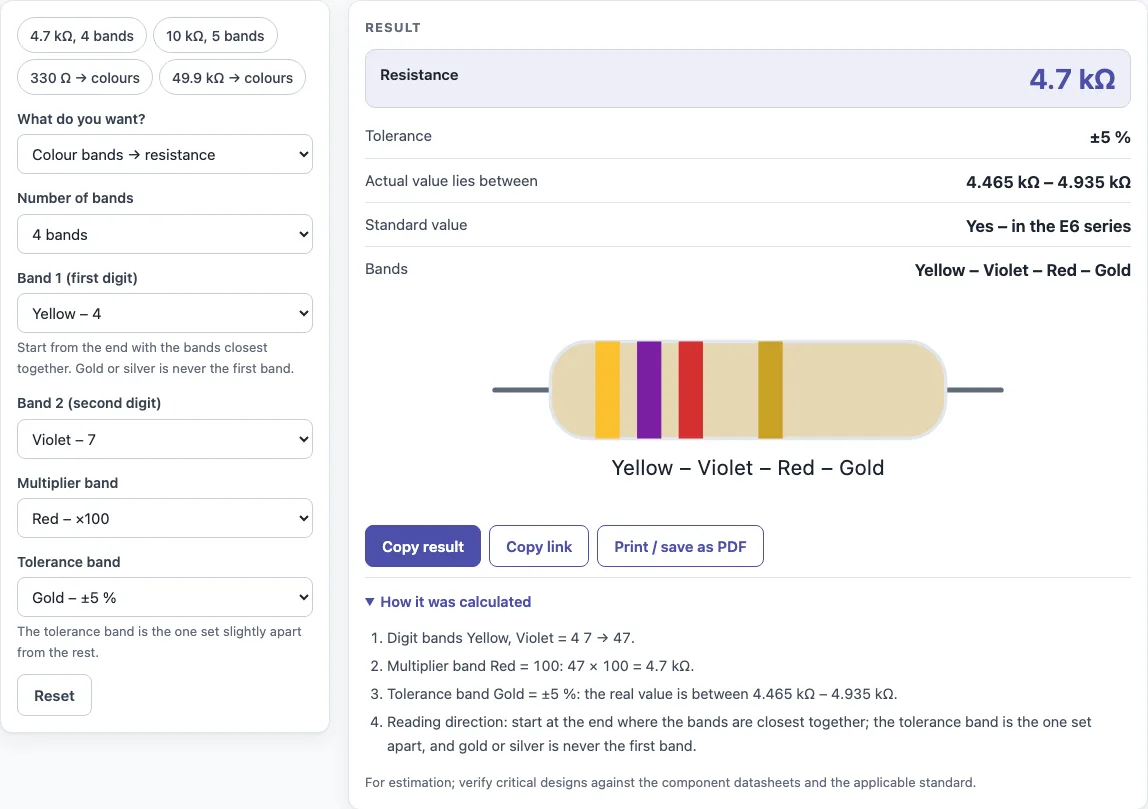
The presets show a four band resistor color code (4.7 kΩ), a 5-band 10 kΩ, and two values to convert into colours. The color coding chart resistor table and the drawing update as you pick each band.
How do you read a resistor color code?
Each color stands for a number. Black is 0, brown 1, red 2, orange 3, yellow 4, green 5, blue 6, violet 7, grey 8 and white 9. On a 4-band resistor, the first two bands are the two significant digits, the third band is the multiplier (the power of ten to multiply by), and the fourth band is the tolerance. A 5-band resistor adds a third digit before the multiplier. A 6-band resistor adds a temperature coefficient band after the tolerance.
The multiplier band uses the same colors, plus gold (×0.1) and silver (×0.01). So yellow–violet–red–gold means 47 × 10² = 4,700 Ω, which is 4.7 kΩ, with a tolerance of ±5 %.
What does the tolerance band tell you?
The tolerance band sets how far the real value may differ from the marked value. Under IEC 60062:2016, brown is ±1 %, red ±2 %, orange ±0.05 %, yellow ±0.02 %, green ±0.5 %, blue ±0.25 %, violet ±0.1 %, grey ±0.01 %, gold ±5 % and silver ±10 %. Older parts marked to EIA RS-279 may use grey for ±0.05 %. With no tolerance band, the tolerance is ±20 %. The minimum and maximum values are the nominal value multiplied by one minus and one plus the tolerance. For 4.7 kΩ ±5 %, the range is 4.465 kΩ to 4.935 kΩ.
Which band do you start from?
Start from the end that does not have gold or silver. The tolerance band is usually set apart from the other bands, and gold or silver is never the first band. This rule makes the reading direction clear on most resistors.
What is the E-series?
The E-series is a set of standard preferred values that manufacturers produce. The calculator shows which series your value belongs to, which helps when you need a part you can buy in a standard size.
How do you read resistor color coding with 5 bands?
Resistor color coding on 5 band resistors uses three digit bands, then the multiplier, then the tolerance: brown–black–black–red–brown is 100 × 10² = 10 kΩ ±1 %. The extra digit allows values such as 49.9 kΩ (yellow–white–white–red–brown) that a four band resistor colour code cannot show.
Sources
Checked October 2026:
- Wikipedia, Electronic color code for the IEC 60062:2016 digits, multipliers, tolerances (grey ±0.01 %; ±0.05 % under the older EIA RS-279) and temperature coefficients
- Vishay resistor marking and the Vishay decade table for E-series values
For estimation; verify critical designs against the applicable standard.
Worked examples
| Input | Result |
|---|---|
| Yellow – Violet – Red – Gold | 4.7 kΩ ±5 % |
| Brown – Black – Black – Red – Brown | 10 kΩ ±1 % |
| Green – Blue – Black – Orange – Brown – Red | 560 kΩ ±1 % |
| 330 Ω, 4-band | Orange – Orange – Brown – Gold |
| 49.9k Ω, 5-band | Yellow – White – White – Red – Brown |
Calculated by the tool above with these values.
Frequently asked questions
Which end of a resistor do I read from?
Read from the end that does not have a gold or silver band. Those colors are never the first band, and the tolerance band is usually set apart from the others.
What does the gold band mean?
Gold has two meanings. As the multiplier, it means ×0.1. As the tolerance band, it means ±5 %. Gold is never the first band.
What are the colors of a 10k resistor?
A 10 kΩ resistor with a 4-band code is brown–black–orange plus a tolerance band, such as gold for ±5 %. A 5-band 10 kΩ resistor with ±1 % tolerance is brown–black–black–red–brown.
What is a 4.7k resistor color code?
A 4.7 kΩ ±5 % resistor is yellow–violet–red–gold. Its minimum value is 4.465 kΩ and its maximum is 4.935 kΩ.
What is the color code for a 100 ohm resistor?
A 100 Ω ±5 % resistor is brown–black–brown–gold. The first two bands are 1 and 0, and the brown multiplier is ×10.
Can I use the results in commercial work?
Yes. Results may be used in commercial work, including designs, quotes, documentation and reports, without attribution.
What color is a 220 ohm resistor?
On a 4-band resistor: red–red–brown, then the tolerance band (gold for ±5 %). Type 220 in the value mode to see it drawn with its bands.
Related tools
- Capacitor code calculator: use it to read the code printed on a capacitor.
- Parallel resistor calculator: use it to find the combined resistance when two or more resistors are wired in parallel.
- LED resistor calculator: use it to choose a current-limiting resistor for an LED.
- Voltage divider calculator: use it to set an output voltage with two resistors.
- Capacitor series parallel calculator: use it to combine capacitor values in series or parallel.
- PT100 table: use it to look up PT100 resistance at a given temperature.
- All calculators: use it to browse every calculator on the site.