Stepper Motor Calculator
Enter the step angle and microstepping to get steps per revolution, pulse rate, speed and linear travel.
This stepper motor calculator turns the numbers on a motor label and a driver into the figures you need to program a move. Enter the step angle and the microstepping setting, and it gives the steps per revolution. Then choose what you want: the pulse rate for a given rpm, the rpm for a given pulse frequency, or the number of steps and the time for a linear move on a lead screw or belt.
It is free, runs in your browser, needs no sign-up, and nothing is uploaded. It is a step motor calculator for the arithmetic only: it does not pick a motor, and it does not check torque, current or the driver’s pulse limit. Use it with the motor and driver data sheets.
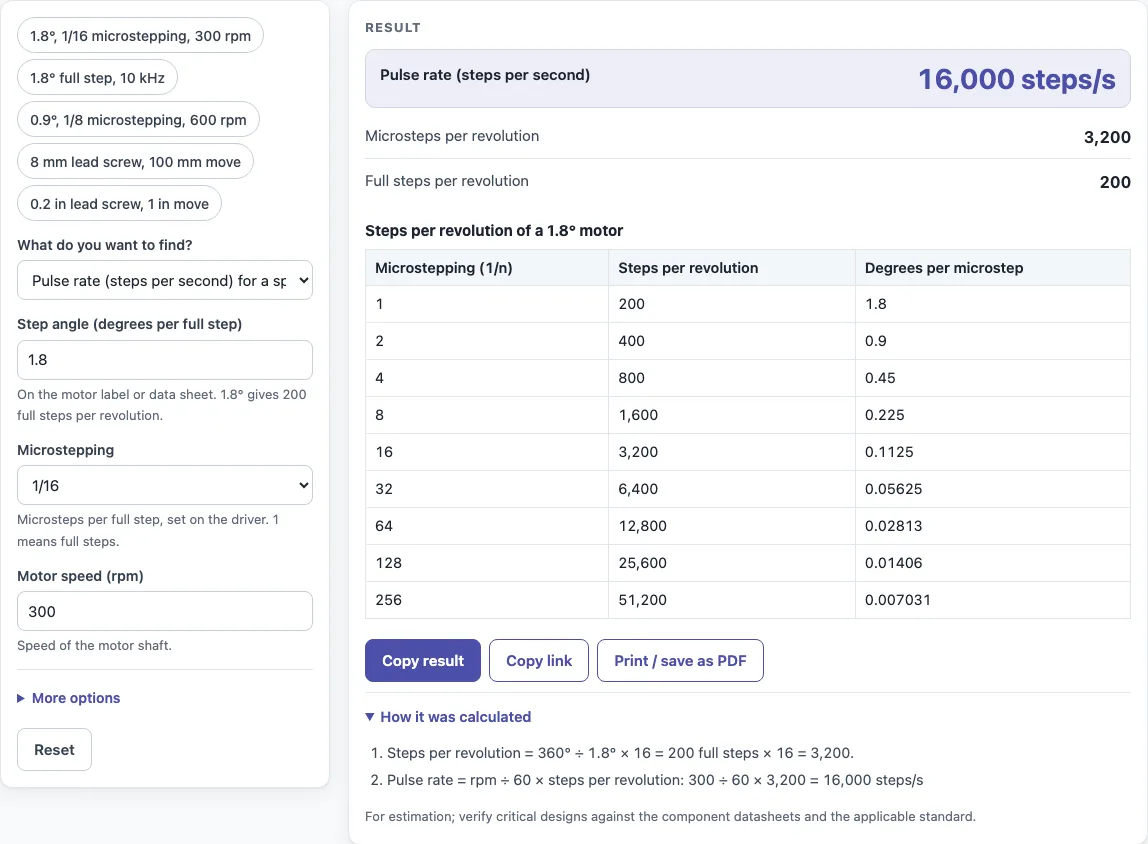
How to use the stepper motor calculator
- In What do you want to find? choose Pulse rate (steps per second) for a speed, Speed (rpm) for a pulse rate, or Steps and time for a linear move.
- Type the Step angle (degrees per full step) from the motor label. 1.8° is the common value.
- Choose Microstepping, the setting on your driver, from 1 (full step) to 1/256.
- For a pulse rate or a move, type the Motor speed (rpm). For the speed mode, type the Step pulse frequency in Hz or kHz instead.
- For a linear move, type the Lead (travel per output revolution) and the Distance to move. Open More options to set the Gear reduction (motor turns per output turn) if a gearbox sits between motor and load.
- Read the main result and the rows below it: Microsteps per revolution, Full steps per revolution, and for a move the Travel per microstep, Time for the move and Linear speed.
The example buttons above the form, such as an 8 mm lead screw moving 100 mm, load a finished case. Open How it was calculated to see each step. Copy result, Copy link and Print / save as PDF sit under the result. Copy link stores your inputs in the page address.
How many steps per revolution does a stepper motor have?
Steps per revolution equal 360° divided by the step angle. A 1.8° motor has 200 full steps per revolution, which is the example Wikipedia’s stepper motor article uses. A 0.9° motor has 400. Microstepping multiplies that number: at 1/16 microstepping a 1.8° motor needs 3,200 pulses per revolution. The table under the result lists all microstepping settings for your step angle.
How do you calculate the pulse frequency for a stepper motor speed?
Pulse rate in steps per second is the speed in revolutions per second times the steps per revolution, or rpm ÷ 60 × steps per revolution. For 300 rpm on a 1.8° motor at 1/16 microstepping that is 5 rev/s × 3,200 = 16,000 pulses per second, or 16 kHz. Check this against the maximum step frequency of your driver or controller.
How do you convert step pulses to rpm?
Divide the pulse frequency by the steps per revolution and multiply by 60. A 10 kHz pulse train on a motor with 200 steps per revolution (full steps) gives 10,000 × 60 ÷ 200 = 3,000 rpm. In practice the motor loses torque as its speed rises, so it may not follow a high step rate.
How many steps does a lead screw move need?
Travel per step is the lead divided by the steps per revolution (and by the gear reduction, if any). With an 8 mm lead and 3,200 steps per revolution each step moves 0.0025 mm, so 100 mm takes 40,000 steps. At 300 rpm that move takes 2.5 s and the carriage travels at 40 mm/s.
What does microstepping change?
Microstepping divides each full step into smaller steps, which makes the motion smoother and the resolution finer, but it does not by itself make the position accurate. Wikipedia’s article notes that resolution is limited by stiction and backlash, so finer microsteps do not by themselves give a more accurate position.
Worked examples
| Input | Result |
|---|---|
| 1.8°, 1/16 step, 300 rpm | 16,000 steps/s |
| 1.8°, 1/1 step, 10 kHz | 3,000 rpm |
| 0.9°, 1/8 step, 600 rpm | 32,000 steps/s |
| 1.8°, 1/16 step, 300 rpm | 40,000 steps, 2.5 s |
| 1.8°, 1/1 step, 120 rpm | 1,000 steps, 2.5 s |
Calculated by the tool above with these values.
Frequently asked questions
What step angle should I enter?
Use the step angle printed on the motor label or in its data sheet, for example 1.8°. If 360 divided by your value is not a whole number, the calculator warns you to check it.
Is one pulse one microstep?
Yes. With a step and direction driver, each pulse on the STEP input moves the motor by one microstep at the driver’s current setting. So the pulse rate rises when you raise the microstepping, for the same speed.
Does it include acceleration?
No. It uses a constant speed. A real move needs a ramp up and down, so the move takes longer than the figure shown. Treat the time as the minimum.
Why does the calculator warn above 200 kHz?
Above 200 kHz is faster than most step and direction inputs accept. The calculator still shows the number, but check the maximum pulse frequency of your driver and controller.
Can the calculator tell me the torque I need?
No. Torque depends on the load, friction, acceleration and the motor’s speed-torque curve, which come from the data sheet. This calculator only handles step counts, rates and travel.
Can I use inches for the lead?
Yes. Choose in beside the lead and the distance. The travel per microstep is always shown in millimetres.
Related tools
- Synchronous speed calculator: use it for the speed of AC motors from frequency and poles.
- Motor torque calculator: use it to find the torque from power and speed.
- Linear actuator calculator: use it to size a screw drive for a load.
- Pneumatic cylinder force calculator: use it to compare an air cylinder with a motor drive.
- PLC simulator: use it to practise ladder logic for a motion sequence.
- All calculators: use it to browse every tool on the site.
Sources
- Stepper motor (Wikipedia): 1.8° per full step = 200 full steps per revolution; microstepping; resolution limited by stiction and backlash
- Steps per revolution = 360° ÷ step angle (follows from the same article); the other relations are unit arithmetic checked in the site’s tests