Synchronous Motor Speed Formula and Calculator
Enter the supply frequency and the number of poles to get the synchronous speed, slip, or the drive frequency for a target speed.
The synchronous motor speed formula is Ns = 120 × f ÷ P, where Ns is the synchronous speed in rpm, f is the supply frequency in hertz, and P is the number of poles. This synchronous speed calculator applies that formula for you and covers the related conversions: Hz to rpm, rpm to Hz, slip, VFD frequency, and pole count. Use it as an hz to rpm calculator, an rpm motor calculator, or an rpm to hertz calculator, depending on which value you already know.
It runs free in your browser with no sign-up, and it works on a phone. Results update as you type, and the page shows each calculation step so you can check the working.
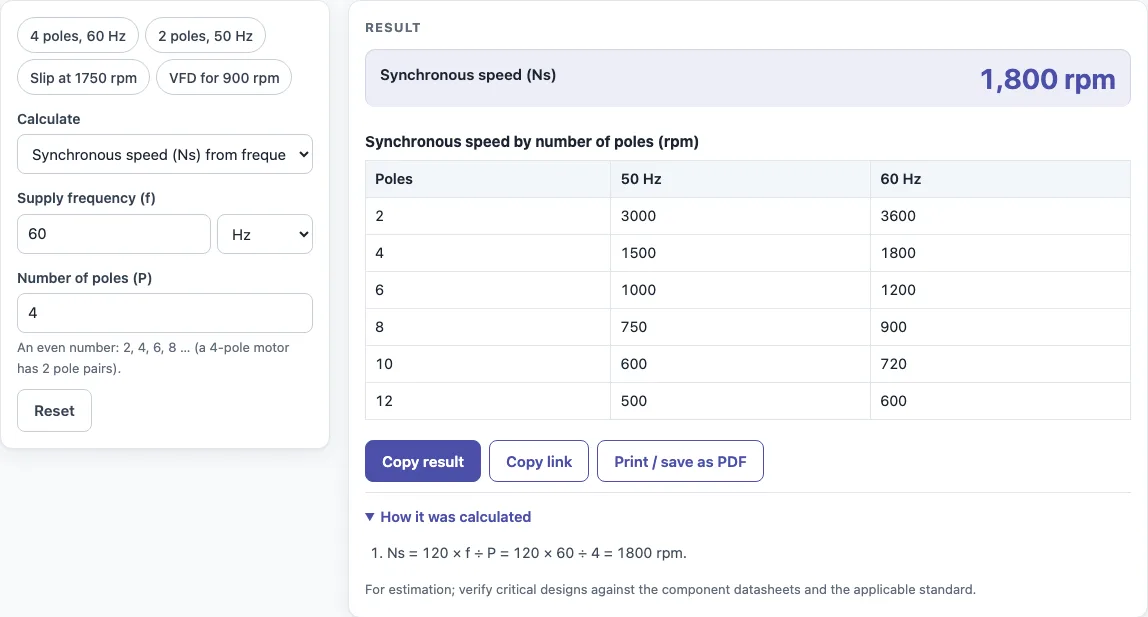
How to use the Synchronous speed calculator
- Choose the mode that matches your problem: synchronous speed from frequency and poles, slip and rotor frequency from the motor’s actual speed, VFD frequency for a target motor speed, or number of poles from a speed.
- For synchronous speed, enter the supply frequency in Hz and the number of poles.
- For slip, enter the motor’s actual speed in rpm, along with the frequency and number of poles.
- For VFD frequency, enter the target motor speed in rpm and the number of poles. If you want the drive frequency corrected for slip, use the slip correction option.
- For number of poles, enter the speed in rpm and the supply frequency in Hz.
- Read the result. It updates as you change any input, so you can try different values without pressing a button.
- Open “How it was calculated” to see the formula with your numbers in each step.
Once the result is right, you can use the output buttons. Copy result copies the result lines with a link back to the calculation. Copy link copies the page address, which stores every input in the link, so opening it later restores the same calculation. Print / save as PDF prints the inputs, results, calculation steps, and the date, which is useful for records or reports.
What is the synchronous speed formula?
The synchronous speed formula is Ns = 120 × f ÷ P. Ns is the speed of the rotating magnetic field in rpm, f is the supply frequency in hertz, and P is the number of poles.
The 120 comes from 60 seconds per minute multiplied by 2, because each pair of poles completes one magnetic cycle per supply cycle. At 60 Hz, a 4-pole motor gives 120 × 60 ÷ 4 = 1800 rpm. Common values are:
- 50 Hz: 2 poles 3000 rpm, 4 poles 1500 rpm, 6 poles 1000 rpm, 8 poles 750 rpm, 10 poles 600 rpm, 12 poles 500 rpm
- 60 Hz: 2 poles 3600 rpm, 4 poles 1800 rpm, 6 poles 1200 rpm, 8 poles 900 rpm, 10 poles 720 rpm, 12 poles 600 rpm
How do you convert Hz to rpm for a motor?
Multiply the frequency in hertz by 120, then divide by the number of poles: rpm = Hz × 120 ÷ poles. For a 60 Hz supply and a 4-pole motor, that is 60 × 120 ÷ 4 = 1800 rpm.
To go the other way, use Hz = rpm × poles ÷ 120. A 4-pole motor at 1800 rpm gives 1800 × 4 ÷ 120 = 60 Hz.
How do you calculate motor slip?
Slip is the difference between synchronous speed and actual speed, expressed as a percentage: slip % = (Ns − N) ÷ Ns × 100. Induction motors always run slightly below synchronous speed, and that difference is what produces torque.
For a 4-pole motor on 60 Hz running at 1750 rpm, Ns is 1800 rpm, so slip = (1800 − 1750) ÷ 1800 × 100 = 2.78 %. The rotor frequency is slip × f, which is 0.0278 × 60 ≈ 1.67 Hz.
What frequency does a VFD need for a given speed?
A variable frequency drive (VFD) needs f = N × P ÷ 120, which is the rpm to Hz formula. Without slip correction, 1200 rpm on a 6-pole motor needs 60 Hz.
A real induction motor runs below synchronous speed, so the drive must set a higher synchronous speed to reach the target. If the motor has 3 % slip, the synchronous speed must be 1200 ÷ (1 − 0.03) ≈ 1237 rpm, and the drive frequency is 1237 × 6 ÷ 120 ≈ 61.86 Hz.
How many poles does a 1800 rpm motor have?
Find the pole count by working backward from the supply frequency: P = 120 × f ÷ Ns. On a 60 Hz supply, 120 × 60 ÷ 1800 = 4 poles.
Actual speed is always a little below synchronous speed, so a nameplate reading near 1750 rpm at 60 Hz also points to 4 poles, since the synchronous speed is 1800 rpm. On a 50 Hz supply, 960 rpm points to 6 poles, because the synchronous speed is 1000 rpm.
Sources
Checked October 2026:
- Wikipedia, Induction motor: synchronous speed n = 120 f / p and slip s = (ns − n) / ns
For estimation; verify critical designs against the applicable standard.
Worked examples
| Input | Result |
|---|---|
| 60 Hz, 4 poles | Ns = 1800 rpm |
| 50 Hz, 2 poles | Ns = 3000 rpm |
| 60 Hz, 4 poles, 1750 rpm | Ns = 1800 rpm, slip = 2.7778 % |
| 1200 rpm, 6 poles, slip 3 % | f = 61.856 Hz |
| 50 Hz, 960 rpm | 6 poles (Ns = 1000 rpm) |
Calculated by the tool above with these values.
Frequently asked questions
Why does my motor run slower than its synchronous speed?
The rotor must turn slightly slower than the rotating magnetic field to induce current in it, so an induction motor always runs a little below synchronous speed. The slip calculation shows exactly how far below it runs.
Can I use the rpm to hertz calculator for any number of poles?
Yes. The formula Hz = rpm × poles ÷ 120 works for any pole count. Enter the target speed and the number of poles, and the result gives the frequency needed.
Does the synchronous speed calculator work on a phone?
Yes. It runs in the browser on a phone, is free, and needs no sign-up. Nothing you enter is uploaded.
Can I use the results in commercial work?
Yes. Results may be used in commercial work such as designs, quotes, documentation, and reports, without attribution.
What speed does a 2-pole motor run at?
Its synchronous speed is 3600 rpm on 60 Hz and 3000 rpm on 50 Hz; the actual speed is a little lower because of slip.
What is the slip of a typical motor?
It depends on the motor and the load; read the nameplate full-load speed and enter it to see the slip, as in the 1750 rpm example (2.78 %).
Related tools
- Motor torque calculator: use it to find the torque a motor delivers once you know its speed and power.
- Linear actuator calculator: use it to size a linear actuator for a load, speed, and duty cycle.
- PLC simulator: use it to test ladder logic that starts, stops, or interlocks a motor before wiring it.
- 4-20 mA calculator: use it to convert between signal current and the measured value in a process loop.
- NEMA enclosure rating chart: use it to check which enclosure type suits a motor’s installation environment.
- All calculators: use it to browse every calculator on the site.