Voltage Divider Formula and Calculator
Enter the input voltage and two resistors to get the output, or solve for a resistor, with load, current and standard values.
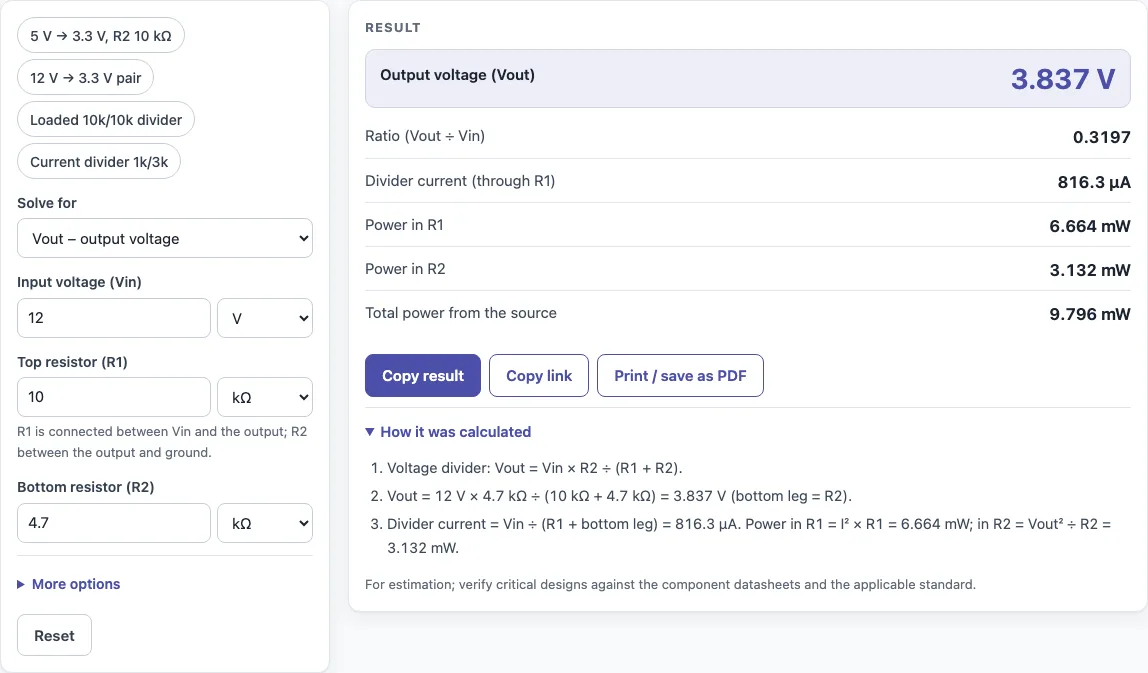
How to use the Voltage divider calculator
- Choose the mode you need: the voltage divider, pair mode (search standard resistor pairs for a target Vout), or current divider mode (two resistors in parallel).
- In voltage divider mode, choose what to solve for: Vout, Vin, R1 or R2.
- Enter Vin, R1 and R2, or the values you already know. The result updates as you type.
- If your circuit has a load, enter RL. It is connected across R2.
- Read the results: Vout, the divider current, the power in R1, R2 and the load, and the unloaded Vout.
- If you solved for R1 or R2, check the nearest E12, E24 and E96 standard values and the Vout error each one gives.
- Open “How it was calculated” to see the formula and each step with your numbers.
In pair mode, enter your target Vout and Vin, then set R1 to a value near what you want. The tool lists the closest pair overall.
Copy result copies the result lines with a link. Copy link copies the page address, which stores every input, so opening it later restores the same calculation. Print / save as PDF prints the inputs, results, calculation steps and the date.
What is the voltage divider formula?
The voltage divider formula is Vout = Vin × R2 ÷ (R1 + R2). This is also called the voltage division formula or potential divider formula, and it describes a resistive voltage divider made from two resistors in series.
The output is taken at the junction between R1 and R2. Because the same current flows through both resistors, the voltage across each one is set by its share of the total resistance.
How do you calculate a voltage divider?
Work out the ratio R2 ÷ (R1 + R2), then multiply it by the input voltage. For example, with Vin = 12 V, R1 = 10 kΩ and R2 = 4.7 kΩ, the ratio is 4.7 ÷ 14.7 = 0.3197, so Vout = 12 × 0.3197 = 3.837 V.
To find a resistor, rearrange the formula. If you need Vout = 3.3 V from Vin = 5 V with R2 = 10 kΩ, the ratio must be 0.66. Then R1 + R2 = 10 kΩ ÷ 0.66 = 15.152 kΩ, so R1 = 5.152 kΩ.
What is the current divider formula?
For two resistors in parallel that share a total current It, the current divider formula is I1 = It × R2 ÷ (R1 + R2) and I2 = It × R1 ÷ (R1 + R2). The current divides in the opposite way to voltage: the larger current flows through the smaller resistor.
For example, if It = 10 mA flows into 1 kΩ in parallel with 3 kΩ, I1 = 10 × 3 ÷ 4 = 7.5 mA through the 1 kΩ resistor, and I2 = 2.5 mA through the 3 kΩ resistor.
How do I choose resistors for a voltage divider?
Start with the ratio Vout ÷ Vin that you need, then pick R2 and solve for R1. Standard values rarely match your calculation exactly, so use the nearest E12, E24 or E96 values and check the Vout error.
Pair mode does this search for you. To divide 5 V down to 3.3 V, the closest pair is 4.7 kΩ and 9.1 kΩ, which gives 3.297 V. Also check the power in each resistor, which the results show, so the parts can handle it.
How does a load affect a voltage divider?
A load connected across R2 changes the output because it sits in parallel with R2. The loaded output uses R2 ∥ RL = R2 × RL ÷ (R2 + RL) in place of R2, so Vout falls.
For example, with Vin = 10 V and R1 = R2 = 10 kΩ, the unloaded output is 5 V. With a 10 kΩ load, the output drops to 3.333 V. A divider works well for references and ADC inputs with a high input impedance. It is not a power supply, so keep the load much larger than R2.
How do I divide 5 V to 3.3 V?
Set the ratio Vout ÷ Vin = 3.3 ÷ 5 = 0.66, then choose the resistors that give that ratio. Pick R2 = 10 kΩ and solve for R1 to get 5.152 kΩ, or use pair mode to find standard values.
The closest standard pair is 4.7 kΩ for R1 and 9.1 kΩ for R2, which gives 3.297 V. That is within a few hundredths of a volt of the target.
Is the voltage divider equation the same as the potential divider equation?
Yes. The voltage divider equation, the potential divider equation and a ‘voltage splitter calculator’ all describe the same circuit: Vout = Vin × R2 ÷ (R1 + R2).
Sources
Checked October 2026:
- Wikipedia, Voltage divider: Vout = Vin R2 / (R1 + R2), loaded with RL in parallel with R2
- Keeping RL at least 10 × R2 is a rule of thumb, not a standard
For estimation; verify critical designs against the applicable standard.
Worked examples
| Input | Result |
|---|---|
| Vin = 12 V, R1 = 10 kΩ, R2 = 4.7 kΩ | Vout = 3.837 V |
| Vin = 5 V, Vout = 3.3 V, R2 = 10 kΩ | R1 = 5.152 kΩ |
| Vin = 10 V, R1 = 10 kΩ, R2 = 10 kΩ, RL = 10 kΩ | Vout = 3.333 V |
| Vin = 5 V, Vout = 3.3 V | R1 = 4.7 kΩ, R2 = 9.1 kΩ → 3.297 V |
| It = 10 mA, R1 = 1 kΩ, R2 = 3 kΩ | I1 = 7.5 mA, I2 = 2.5 mA |
Calculated by the tool above with these values.
Frequently asked questions
What is the voltage divider formula?
Vout = Vin × R2 ÷ (R1 + R2). R1 is the resistor connected to Vin, and R2 is the resistor connected to ground.
How do you calculate a voltage divider?
Find the ratio R2 ÷ (R1 + R2) and multiply it by Vin. The calculator does this for you and shows each step under “How it was calculated.”
What is the current divider formula?
For two parallel resistors, I1 = It × R2 ÷ (R1 + R2) and I2 = It × R1 ÷ (R1 + R2). The larger current flows through the smaller resistor.
How do I choose resistors for a voltage divider?
Choose R2, solve for R1, then use the nearest standard E12, E24 or E96 values. Check the Vout error and the power in each resistor.
How does a load affect a voltage divider?
A load across R2 lowers Vout, because R2 is effectively replaced by R2 ∥ RL. Keep the load much larger than R2 to limit the change.
How do I divide 5 V to 3.3 V?
Use R2 = 10 kΩ and R1 = 5.152 kΩ, or the standard pair 4.7 kΩ and 9.1 kΩ, which gives 3.297 V.
Can I use this calculator on my phone?
Yes. It runs in your browser and works on a phone. It is free and needs no sign-up.
Related tools
- Parallel resistor calculator: use it to combine resistors in parallel, such as the two branches of a current divider.
- Resistor color code calculator: use it to read the value of a resistor from its color bands.
- LED resistor calculator: use it to size a series resistor for an LED.
- Op amp gain calculator: use it to find the gain of an op amp circuit set by its resistors.
- 4-20 mA calculator: use it to convert between current loop signals and their values.
- All calculators: use it to browse every calculator on this site.