Wavelength and Frequency Calculator
Convert frequency to wavelength or wavelength to frequency for light, radio in a cable or sound, with photon energy and antenna lengths.
The wavelength and frequency calculator converts between wavelength and frequency for any wave, using λ = v ÷ f and f = v ÷ λ, where v is the wave speed. Enter one value and it returns the other, along with the period, half-wave and quarter-wave lengths, and photon energy for light and radio. It covers light and radio in vacuum, signals in cable, and sound in air or water, and it accepts a custom speed. The tool runs in your browser, is free, needs no sign-up, and works on a phone. Results update as you type.
It works both ways, as a frequency to wavelength converter and a wavelength to frequency converter.
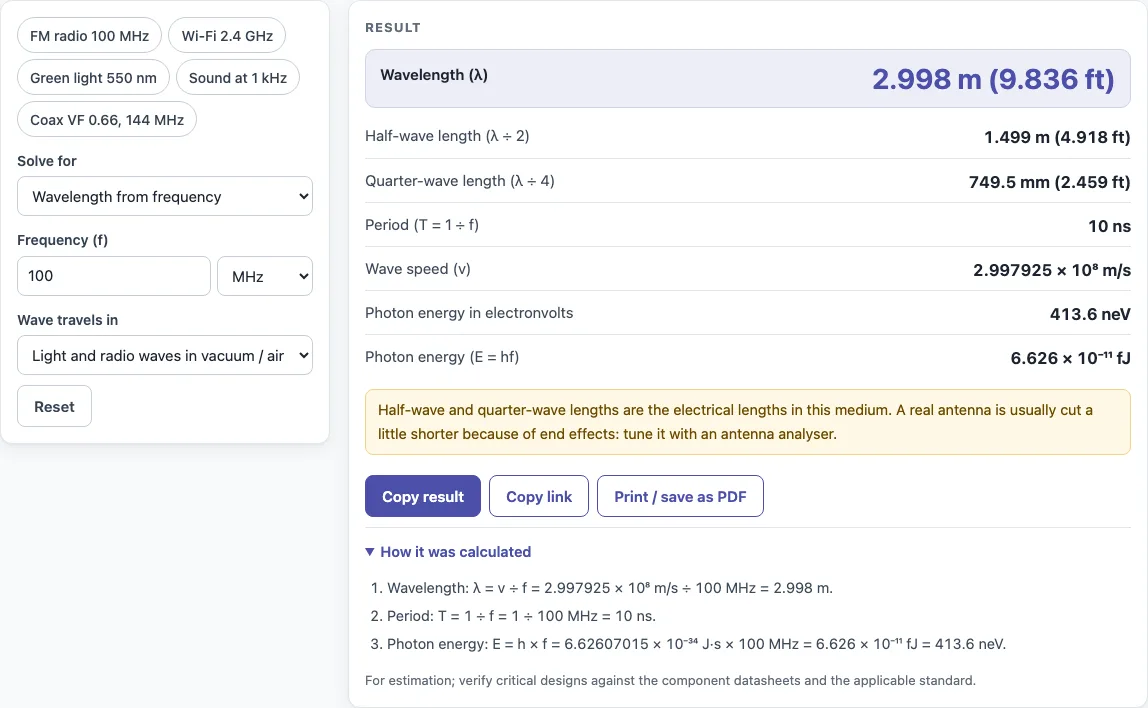
How to use the Wavelength and Frequency Calculator
- Enter what you know. Type a frequency (units from Hz to THz) or a wavelength (units from nm to km).
- Choose the wave speed. Pick light or radio in vacuum, cable or transmission line, sound in air, sound in water, or a custom speed.
- Set the speed details. For cable, enter the velocity factor, such as 0.66. For sound in air, use the standard 343 m/s at 20 °C or enter a temperature.
- Read the results. You will see the wavelength or frequency, the period T = 1 ÷ f, and the half-wave and quarter-wave lengths (λ/2 and λ/4) in metres and feet. For light and radio, photon energy appears in joules and electronvolts.
- Check the working. Open “How it was calculated” to see the formula and each step with your numbers.
- Save or share. Use Copy result to copy the result lines with a link, or Copy link to copy the page address. The address stores every input, so opening it later restores the same calculation. Print / save as PDF produces a copy with your inputs, results, steps and the date.
The presets show FM radio at 100 MHz, Wi-Fi at 2.4 GHz, green light at 550 nm, sound at 1 kHz and coax with a 0.66 velocity factor at 144 MHz.
What is the formula for wavelength and frequency?
The formula is λ = v ÷ f, where λ is the wavelength in metres, v is the wave speed in metres per second, and f is the frequency in hertz. Rearranged, f = v ÷ λ, so if you know the speed and one of the other two values, you can find the third.
The speed depends on what the wave travels through. Light and radio waves in vacuum travel at c = 299,792,458 m/s. Sound in air travels at about 343 m/s at 20 °C. Because the speed is fixed for a given medium, the two quantities are inversely linked: a higher frequency gives a shorter wavelength.
For example, FM radio at 100 MHz has λ = 299,792,458 ÷ 100,000,000 = 2.998 m. The period of the same wave is T = 1 ÷ f = 10 ns.
What is velocity factor in a cable?
Velocity factor is the fraction of the speed of light at which a signal travels through a cable or transmission line. The speed inside the cable equals c × velocity factor, so a velocity factor of 0.66 means the signal moves at 66% of c.
Because the signal is slower in cable, its wavelength is shorter than in free space at the same frequency. For 144 MHz in coax with a velocity factor of 0.66, the speed is about 197,863,022 m/s, and λ = 197,863,022 ÷ 144,000,000 ≈ 1.374 m (4.508 ft). A quarter-wave stub at this frequency is therefore about 0.344 m long.
How do you do a wavelength to frequency conversion?
Divide the wave speed by the wavelength: f = v ÷ λ. Green light at 550 nm has f = 299,792,458 ÷ 0.000000550 ≈ 545 THz, and a 2 m radio wave is about 150 MHz.
Sources
Checked October 2026:
- NIST CODATA: speed of light c = 299,792,458 m/s, Planck constant and electronvolt
- Wikipedia, Speed of sound for 343 m/s in air at 20 °C
For estimation; verify critical designs against the applicable standard.
Worked examples
| Input | Result |
|---|---|
| f = 100 MHz, light in vacuum | λ = 2.998 m (9.836 ft) |
| f = 1 kHz, sound in air | λ = 331.3 mm (1.087 ft) |
| f = 144 MHz, cable | λ = 1.374 m (4.508 ft) |
| f = 2.4 GHz, light in vacuum | λ = 124.9 mm (0.4098 ft) |
| f = 1 kHz, sound in air | λ = 343 mm (1.125 ft) |
| λ = 550 nm, light in vacuum | f = 545.1 THz |
Calculated by the tool above with these values.
Frequently asked questions
How do you convert frequency to wavelength?
Divide the wave speed by the frequency: λ = v ÷ f. Enter the frequency in Hz, kHz, MHz, GHz or THz, and the calculator performs the division. For 2.4 GHz light in vacuum, λ = 124.9 mm.
How do you calculate the wavelength of a radio wave?
Use λ = c ÷ f with c = 299,792,458 m/s for radio in vacuum. FM radio at 100 MHz gives 2.998 m (9.84 ft). For a radio signal in cable, multiply c by the velocity factor first.
What is the wavelength of sound at 1 kHz?
In air at 20 °C, with v = 343 m/s, λ = 343 ÷ 1000 = 0.343 m, or 343 mm. At 0 °C the speed is 331.3 m/s, which gives 331.3 mm.
How do you calculate antenna length from frequency?
Find the wavelength with λ = v ÷ f, then take half of it for a half-wave length (λ/2) or a quarter of it for a quarter-wave length (λ/4). The tool shows both in metres and feet. It gives only the lengths, so check antenna design guidance before you build.
Can the calculator find photon energy?
Yes, for light and radio it gives E = h f in joules and electronvolts, using h = 6.62607015 × 10⁻³⁴ J·s. For 550 nm green light, the frequency is 545 THz.
Does the calculator work for sound in water?
Yes. Choose sound in water, which uses 1481 m/s at 20 °C, or enter a custom speed for another medium.
Related tools
- Decibel calculator: use it to convert power or voltage ratios to decibel values.
- Reactance calculator: use it to find the reactance of a capacitor or inductor at a given frequency.
- Low pass filter calculator: use it to find the cutoff frequency of a low-pass filter.
- PCB trace width calculator: use it to size a printed circuit board trace for a required current.
- Inductance calculator: use it to work out inductance from coil or wire dimensions.
- All calculators: use it to browse every tool on the site.